
Omada AX3000 Wireless Access Point EAP650
4.5Editor score
Free Omada Essentials cloud management included
Ultra-fast true Wi-Fi 6 speeds
Integrated into Omada SDN platform
This comprehensive guide compares the top ten commercial wireless router options available in the market to help businesses find the best network solution for
Selecting the right commercial wireless router is critical for modern business operations. Reliable connectivity ensures smooth communication and productivity across all departments without interruption.
We compared ten top-rated models based on security features speed capabilities and management tools. Each product offers unique advantages for different business sizes and specific networking requirements.
Each pick highlights key strengths and ideal use cases for your organization. Please note that prices and availability may change frequently so verify details before purchasing today.
4.5Editor score
4.2Editor score

4.3Editor score
Here is a side-by-side comparison of all ten commercial wireless routers reviewed in this guide to help you quickly identify the best fit for your network.





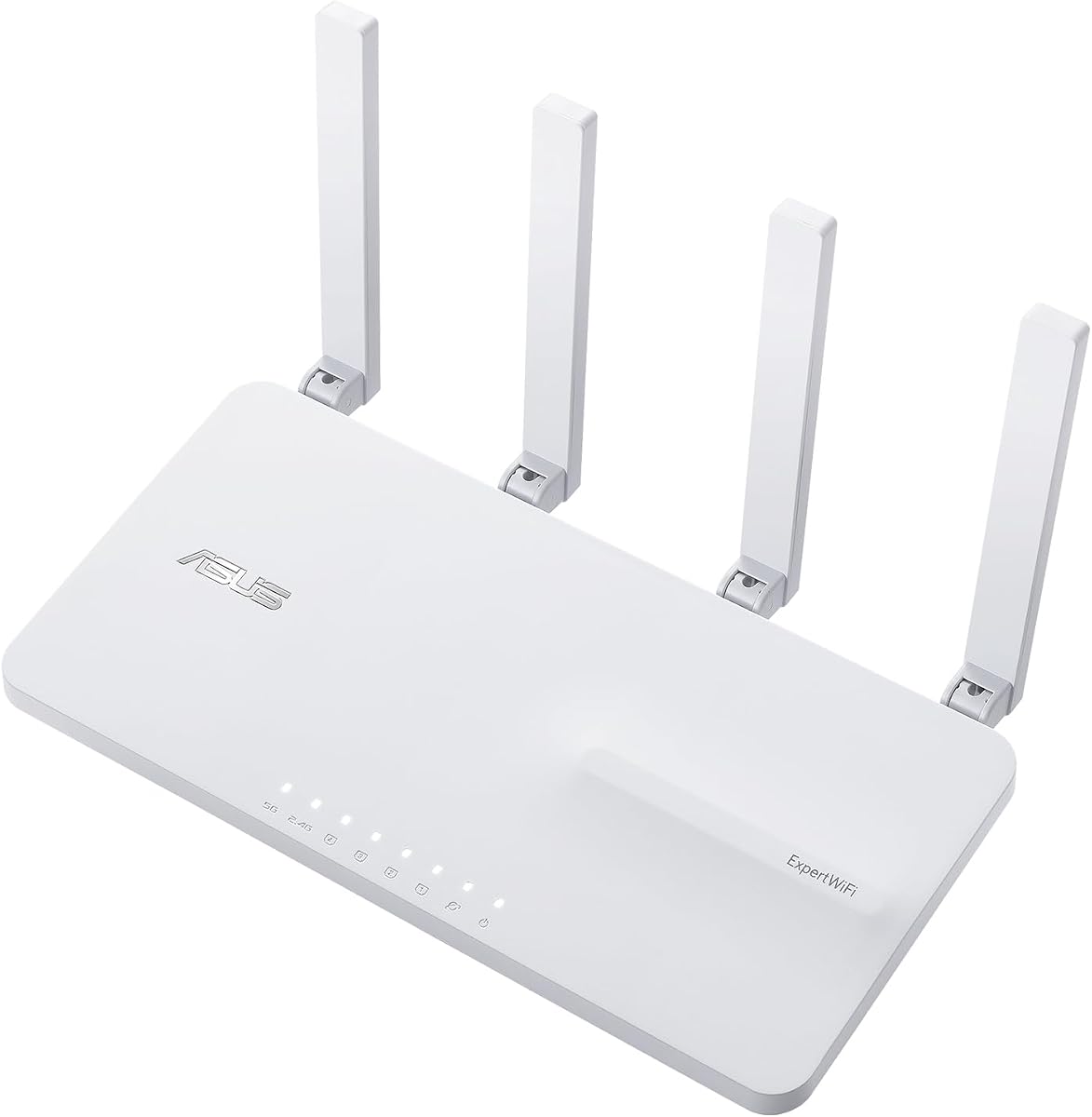
The ASUS ExpertWiFi EBR63 is a robust commercial wireless router designed specifically for small to medium businesses requiring secure connectivity. It holds a solid 4.2 rating and stands out for its ability to separate network traffic efficiently without complex hardware setups.
We may earn a commission when you buy through this link, at no additional cost to you.
Its key strengths include the customizable guest portal which allows businesses to tailor the login experience to their brand. The separate SSID feature ensures employee devices do not interfere with guest traffic. Additionally the free AiProtection Pro subscription adds enterprise-level security layers at no extra cost.
Honest trade-offs involve its reliance on older Wi-Fi 6 standards instead of the newer 7 which might limit future proofing. The maximum throughput is adequate for most SMBs but may struggle with extremely high density environments compared to enterprise grade access points.
Businesses needing a simple scalable solution with strong guest network features should buy this router. It offers the best balance of ease of use and security features in this price category.
The customizable guest portal allows you to modify the SSID and templates to fit your business style perfectly.
Receive a free subscription to ASUS AiProtection Pro and safe browsing features to secure your WiFi environment immediately.
We may earn a commission when you buy through this link, at no additional cost to you.
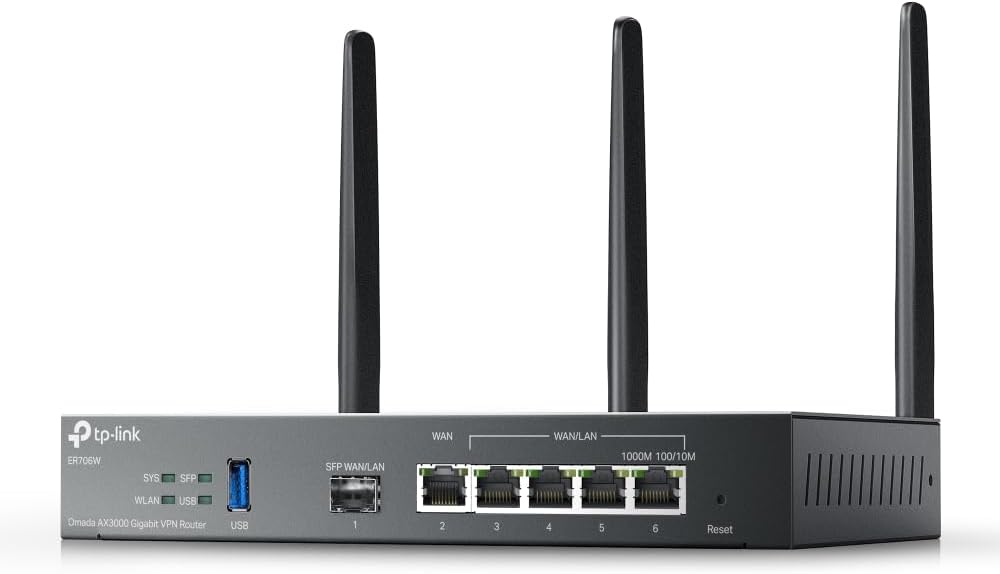
The Omada ER706W is a Gigabit AX3000 WiFi 6 VPN Router that excels in reliability and connection management. It is rated well for its ability to handle multiple internet lines and secure data transmission effectively for growing businesses.
We may earn a commission when you buy through this link, at no additional cost to you.
Key strengths include the load balancing feature which raises utilization rates across up to five WAN ports. This ensures stable connectivity even if one line fails. The high security options like SSL and IPSec protect data moving across the network.
Trade-offs exist as this router is designed primarily for network integration requiring the Omada SDN controller for full functionality. It lacks some consumer friendly interface elements that might be preferred by users without dedicated IT support.
Organizations needing robust load balancing and strong VPN capabilities should choose this router. It fits well into managed network environments where security and uptime are paramount priorities.
Load Balancing on up to five WAN ports raises the utilization rate of multi-line broadband connections effectively.
High-security SSL and IPSec and WireGuard and PPTP and L2TP and OpenVPN are supported for safe transmission.
We may earn a commission when you buy through this link, at no additional cost to you.
The Ruckus R750 is an Indoor Wi-Fi 6 Access Point built specifically for ultra-dense environments. It is rated highly for its ability to maintain performance in crowded spaces where many devices connect simultaneously to the network.
We may earn a commission when you buy through this link, at no additional cost to you.
Key strengths lie in its capacity to handle high traffic loads without significant latency. This makes it ideal for venues like auditoriums or busy offices. The technology ensures stable connections even when many users access data heavily at once.
The trade-off is that it functions as an access point rather than a standalone router requiring integration with a controller. This increases initial setup complexity but provides the necessary scalability for larger commercial deployments.
Businesses facing high device density issues should buy this access point. It delivers the necessary capacity to keep networks running smoothly in crowded professional settings.
Designed specifically for ultra-dense environments to maintain performance where many devices connect simultaneously.
We may earn a commission when you buy through this link, at no additional cost to you.
The Ruckus R670 is an Indoor Access Point featuring Wi-Fi 7 technology designed for mainstream deployment. It holds a strong rating for its exceptional end-user experience and future-proof capabilities in meeting rooms and classrooms.
We may earn a commission when you buy through this link, at no additional cost to you.
Key strengths include the BeamFlex+ adaptive antenna technology which maximizes signal coverage and network capacity. The 5 GbE port eliminates bottlenecks when connecting to multi-gigabit switches. This ensures seamless high-speed data transfer for demanding applications.
Trade-offs involve the high price point and potential hardware availability challenges during initial launches. While expensive the investment pays off in environments where top-tier performance and reliability are non-negotiable requirements.
Organizations needing cutting-edge speed and high capacity should buy this access point. It represents a significant leap forward in commercial wireless networking performance.
BeamFlex+ Adaptive Antenna Technology offers first-of-its-kind smart antenna technology that maximizes signal coverage.
The latest Wi-Fi security standard with WPA3 and receive enhanced protection from man-in-the-middle attacks.
We may earn a commission when you buy through this link, at no additional cost to you.
The NETGEAR Orbi 970 Series is a WiFi 7 Mesh System designed for whole-home coverage. It is highly rated for its ability to blanket large areas with fast reliable WiFi without dead zones using a three-pack configuration.
We may earn a commission when you buy through this link, at no additional cost to you.
Key strengths include the dedicated Quad-Band technology which reserves a lane for satellite traffic to prevent slowdowns. This ensures every device stays fast simultaneously. The system supports up to 200 devices making it robust for busy networks.
Trade-offs involve the high investment cost and the requirement for a separate modem. While expensive it provides unparalleled coverage for large commercial buildings or homes with complex layouts.
Businesses requiring seamless large-area connectivity should buy this mesh system. It offers the best balance of speed and reach for extensive commercial spaces.
Exclusive patented Quad-Band technology with Enhanced Dedicated Backhaul reserves a dedicated lane for satellite traffic.
We may earn a commission when you buy through this link, at no additional cost to you.
The Omada EAP650 is a Wireless Access Point that offers exceptional value for businesses. It is highly rated for its fast true Wi-Fi 6 speeds and free cloud management features that simplify network administration significantly.
We may earn a commission when you buy through this link, at no additional cost to you.
Key strengths include the free Omada Essentials Cloud Management which removes the need for additional hardware controllers. This reduces costs while maintaining centralized control. The ultra-slim design ensures it blends into modern office or hotel environments effortlessly.
Trade-offs involve the need for PoE support or an adapter which might require extra infrastructure investment. While limited in standalone mode it shines when integrated into the broader Omada SDN platform.
Organizations seeking cost-effective expansion should buy this access point. It delivers strong performance and management tools at an unbeatable price point.
Free Omada Essentials Cloud Management allows everything to be managed in the cloud without the need for hardware controllers.
We may earn a commission when you buy through this link, at no additional cost to you.
The Ubiquiti U6+ is a Dual Band Wireless Access Point designed to create reliable business networks. It is rated highly for its high-speed data transfer rate and secure connectivity features that protect valuable business data.
We may earn a commission when you buy through this link, at no additional cost to you.
Key strengths include the Gigabit Ethernet port which ensures ultra-fast wired network speeds for connected devices. The PoE+ port allows data and power through a single cable simplifying installation in difficult locations.
Trade-offs involve the requirement for UniFi hardware controllers for full functionality. While powerful this adds complexity for users not already invested in the Ubiquiti ecosystem.
Businesses needing secure and fast connectivity should buy this access point. It provides the reliability required for professional daily operations.
PoE+ port to receive data and power of up to 25.5W through a single cable in places where a power outlet is not available.
We may earn a commission when you buy through this link, at no additional cost to you.
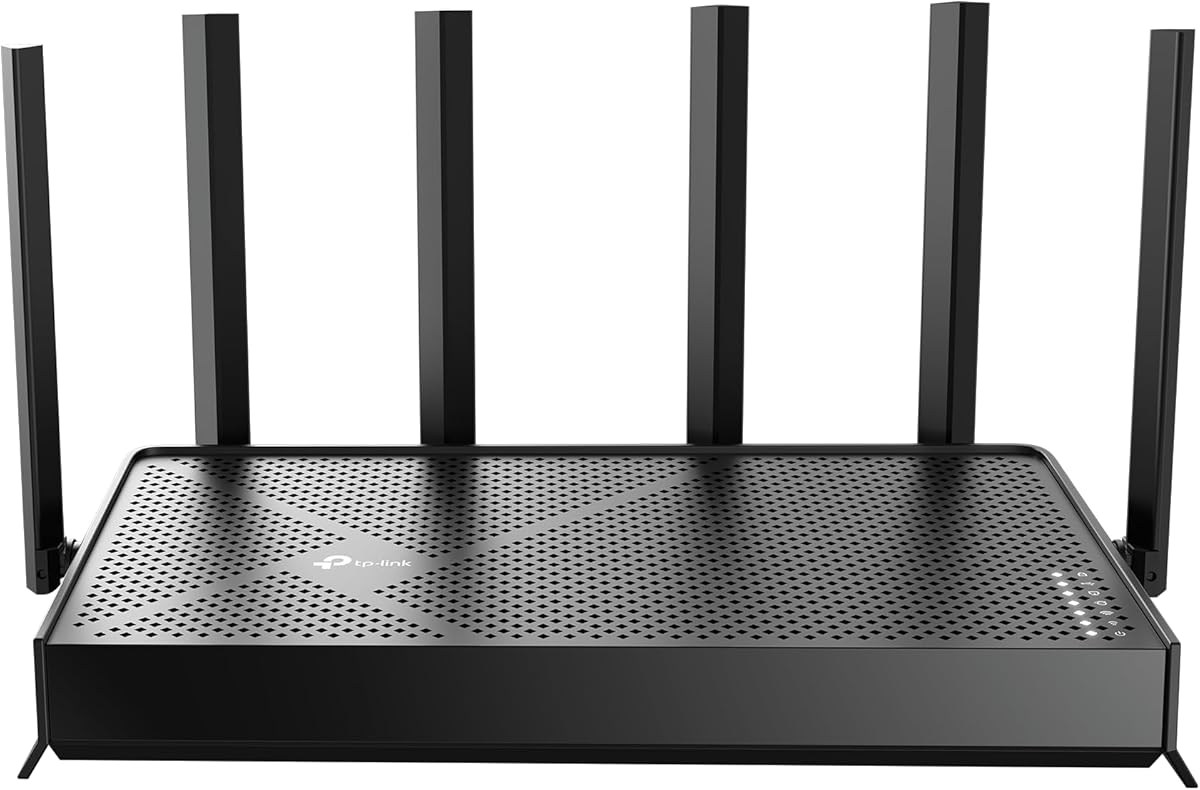
The TP-Link BE6500 is a Dual-Band WiFi 7 Router that positions businesses for future network demands. It is highly rated for its Multi-Link Operation which delivers enhanced throughput and lower latency for modern devices.
We may earn a commission when you buy through this link, at no additional cost to you.
Key strengths include the commitment to security with Secure-by-Design pledge ensuring safety is a core requirement. The 2.5 Gbps WAN and LAN ports support multi-gigabit internet plans for fast file transfers.
Trade-offs involve mesh compatibility being limited to EasyMesh routers rather than other TP-Link Deco systems. This restricts expansion options for users already committed to different mesh ecosystems.
Businesses needing high throughput and future-proofing should buy this router. It offers solid performance for demanding modern networking tasks.
Simultaneously transfers data across frequency bands delivering enhanced throughput lower latency and improved reliability.
We may earn a commission when you buy through this link, at no additional cost to you.
The NETGEAR Nighthawk WiFi 7 Router is designed for busy homes and small commercial spaces. It is highly rated for its dedicated tri-band design which keeps fastest devices running smoothly without slowing down.
We may earn a commission when you buy through this link, at no additional cost to you.
Key strengths include the 9.3 Gbps speed across 2.4 GHz 5 GHz and 6 GHz bands. This provides ample capacity for streaming and video calls. The 2.5 Gig WAN port unlocks multi-gig internet plans for fast wired connections.
Trade-offs involve coverage limited to 2500 square feet which may not suit larger buildings. Users with multi-story layouts might need to add a mesh satellite for full coverage.
Businesses needing high speed in compact areas should buy this router. It delivers excellent performance for streaming and professional video conferencing.
A dedicated tri-band WiFi 7 router with a third high-speed band for demanding devices to keep up as your connected home grows.
We may earn a commission when you buy through this link, at no additional cost to you.
The ASUS RT-BE88U is a powerful WiFi 7 Router designed to bolster wired network capacity. It is highly rated for its two 10G ports which provide up to 34G total wired capacity for demanding applications.
We may earn a commission when you buy through this link, at no additional cost to you.
Key strengths include the blazing-fast wireless throughput up to 7200Mbps with Multi-Link Operation. The AI WAN detection ensures always-on internet through versatile configuration options. This ensures reliability for critical business operations.
Trade-offs involve the high cost which may be steep for smaller businesses. The power usage is also significant requiring adequate cooling in confined spaces.
Businesses needing high capacity wired and wireless connections should buy this router. It supports demanding applications and future-proof networking needs.
Bolster your wired network capacity up to 34G with one cutting-edge 10G SFP+ port and one standard 10G WAN/LAN port.
We may earn a commission when you buy through this link, at no additional cost to you.
Choosing the right commercial wireless router involves understanding your specific business needs including device count security requirements and coverage area.
Modern businesses should look for routers supporting the latest Wi-Fi 6 or Wi-Fi 7 standards. These provide higher speeds lower latency and better performance in dense environments compared to older models.
Prioritize routers with high total throughput speeds to support multiple simultaneous connections without slowing down.
Consider the maximum number of devices the router can handle. A commercial router must support dozens or even hundreds of connections simultaneously including phones laptops and smart office devices.
Select models explicitly rated for high device capacity to ensure stable performance for all users.
Security is paramount in commercial settings. Look for routers with built-in protection against malware and intrusion along with support for WPA3 encryption standards.
Ensure the router offers easy-to-use security settings and regular automatic firmware updates to stay safe from vulnerabilities.
Easy management allows you to configure guest networks track usage and update settings remotely. Apps or cloud-based dashboards simplify this process for non-technical staff.
Choose a router with intuitive interfaces that save time on daily administration and troubleshooting.
Coverage area must match your physical space size. Some routers support mesh connectivity allowing you to add satellites to expand coverage without losing signal quality.
Look for models compatible with mesh networks to ensure seamless roaming as your business grows.
Check for the number and type of Ethernet ports. High-speed LAN ports are essential for connecting wired devices like servers or smart TVs efficiently.
Prioritize routers with enough ports to support your wired devices without needing extra switches.
Virtual Private Network support is crucial for remote work security. Ensure the router supports multiple protocols like OpenVPN or IPsec for secure data transmission.
Select routers that allow remote access and secure tunnels for employees working offsite.
Commercial equipment often requires reliable technical support and a solid warranty. Look for brands offering long warranty periods and accessible customer service channels.
Ensure you have access to timely assistance if connectivity issues arise during business hours.
To set up your commercial wireless router start by placing it in a central elevated location away from metal objects or other electronics. Connect it to your modem using an Ethernet cable and plug in the power adapter.
Use the provided management app to access the router interface and set your SSID and secure password. Configure guest networks to separate visitor traffic from internal business data for better security.
Regularly update the firmware through the app to ensure you have the latest security patches. Monitor connected devices and restart the router occasionally to clear temporary cache and maintain performance.
Commercial grade routers offer enhanced security protocols better device management tools and more durable hardware. They typically support higher device counts and provide options like VLANs and multiple SSIDs for organized business networking.
If your router lacks enough Ethernet ports for your wired devices you will need a network switch. Most commercial routers have a few ports so adding a switch expands your wired connection capacity.
You should update your router firmware whenever the vendor releases a new version. Automatic updates ensure security patches are applied promptly reducing the risk of vulnerabilities.
A guest portal is a login page visitors see when connecting to guest WiFi. It can include branding or terms of service. This feature enhances security by isolating guest traffic from internal networks.
Yes most commercial routers support backward compatibility. Newer WiFi 7 devices will connect to a WiFi 6 router but at reduced speeds. Future upgrades ensure maximum performance for all clients.
Mesh WiFi uses multiple nodes to cover a large area with one unified network. Instead of extending signal it creates a seamless web. This ensures consistent speeds and roaming without drops.
Selecting the right commercial wireless router depends heavily on your specific network needs and budget. The ASUS ExpertWiFi EBR63 and Omada EAP650 stand out for value and ease of use respectively.
Prioritize routers that offer strong security features and the capacity to handle your device load. Investing in reliable management tools will save time and reduce troubleshooting efforts over the long term.
Remember that availability and pricing can change quickly so verify the latest specs before finalizing your decision. Choose the model that best fits your immediate goals and future growth plans.