
ESP8266 ESP-01S
4.4Editor score
Affordable wireless connectivity
Compact serial transceiver design
Supports AP and STA modes
Discover the top Arduino WiFi Module options for 2026. We compare features, performance, and connectivity to help you choose the best wireless board for your
Connecting your Arduino projects to the internet opens up a world of possibilities for automation and data tracking. Selecting the right WiFi module is crucial for ensuring reliable communication and smooth operation in your embedded systems.
We have carefully evaluated ten leading options based on their wireless capabilities, ease of integration, and overall performance. This guide covers everything from classic ESP8266 modules to the latest integrated boards with dual-core processing.
Each pick highlights specific strengths to help you match a device to your unique application needs. Please note that product availability and pricing can change frequently so verify details before purchasing.
4.4Editor score

4.7Editor score

4.5Editor score
This side-by-side comparison highlights the key specifications and capabilities of each reviewed product to help you make an informed decision for your next IoT development project.



The Arduino UNO R4 WiFi stands out as a top choice for developers needing robust wireless capabilities combined with classic Arduino compatibility. It earns a high rating for its versatile dual-core architecture that simplifies complex IoT tasks.
We may earn a commission when you buy through this link, at no additional cost to you.
Its standout feature is the integration of the Renesas RA4M1 microcontroller alongside the ESP32-S3 WiFi chip. This setup allows for efficient handling of high-speed communications while maintaining real-time processing for data applications.
While it offers premium features like a built-in LED matrix and USB-C port, users should be aware of the learning curve associated with the new architecture. The additional power and connectivity options justify the cost for advanced projects.
This board is ideal for professionals and educators working on sophisticated smart home or industrial automation systems. If you need a reliable WiFi module that reduces wiring complexity, this is a strong recommendation.
The built-in ESP32-S3 ensures stable Wi-Fi and Bluetooth 5.0 connections without external shields.
The 12×8 LED matrix allows for immediate visual feedback on status or messages directly on the board.
We may earn a commission when you buy through this link, at no additional cost to you.
This 3-pack of ESP8266 ESP-01 modules provides an affordable entry point for adding wireless connectivity to your projects. It is widely recognized for its powerful on-board processing and storage capabilities.
We may earn a commission when you buy through this link, at no additional cost to you.
The modules support three distinct modes including AP, STA, and AP+STA which offers versatility for different networking scenarios. This flexibility allows you to act as a server or connect to existing networks seamlessly.
Due to their small size, these modules often require a breakout board or careful wiring to integrate properly into larger breadboard setups. Users must also ensure voltage levels are managed correctly to avoid damage.
It is a practical choice for hobbyists needing multiple units for distributed sensor networks. If you prioritize cost-effectiveness and basic connectivity over advanced features, this bundle serves well.
Buying in a pack of three ensures you have replacements ready for ongoing prototype development.
The AP+STA mode allows the device to connect to a router while simultaneously hosting its own network.
We may earn a commission when you buy through this link, at no additional cost to you.
The ESP8266 ESP-01S is a classic choice for budget-conscious builders who need reliable wireless functionality. It features a significant upgrade in flash memory compared to earlier versions.
We may earn a commission when you buy through this link, at no additional cost to you.
With 4MB of flash memory this module can store more complex sketches and web server content without running out of space quickly. The stronger signal performance also improves range and stability in challenging environments.
While the hardware is excellent, the lack of a direct USB interface means you will need a separate adapter to upload code. This extra step adds to the overall cost but keeps the module itself inexpensive.
This is the go-to option for students or makers creating simple smart home sensors. If you need to balance performance with the lowest possible cost this module delivers exceptional value.
The increased flash memory allows for storing more data locally before transmitting to the cloud.
Enhanced antenna design and internal tuning help maintain connections over longer distances.
We may earn a commission when you buy through this link, at no additional cost to you.
This five-pack of ESP8266 ESP-01 modules offers excellent value for projects requiring multiple nodes. It supports a wide range of applications from smart grids to intelligent transportation systems.
We may earn a commission when you buy through this link, at no additional cost to you.
The modules are ready for Arduino and NodeMCU platforms making them versatile for various development environments. They operate on 3.3V which is standard for logic circuits but requires careful power management.
Care must be taken to avoid using 5V power supplies directly on the module to prevent permanent damage. Soldering pins to the module is often necessary for a secure connection in prototyping setups.
It is an ideal choice for those building distributed sensor networks needing multiple units. If you want a reliable and proven wireless solution at a low price point this pack is suitable.
Having five modules allows you to build a mesh network or multiple independent devices simultaneously.
Support for AT commands ensures broad compatibility with microcontrollers like Arduino or STM32.
We may earn a commission when you buy through this link, at no additional cost to you.
These ESP-32 development boards offer a step up in processing power with a dual-core architecture designed for responsive IoT projects. They feature integrated Bluetooth and WiFi connectivity for versatile communication options.
We may earn a commission when you buy through this link, at no additional cost to you.
The USB-C port simplifies connection and power delivery significantly. This modern interface also supports the CP2102 for efficient programming and serial monitoring during development phases.
Users should note that the USB-C cable is not included with the purchase which might be an inconvenience for first-time buyers. Also the power requirements are higher than the simpler ESP8266 series.
This set is perfect for developers needing high performance and modern connectivity standards. If you require dual-core processing for complex tasks these boards provide a robust foundation.
The 240 MHz dual-core CPU handles complex logic and wireless tasks simultaneously without bottlenecks.
Firmware can be updated remotely over WiFi which simplifies maintenance for deployed devices.
We may earn a commission when you buy through this link, at no additional cost to you.
This board brings the power of the ESP32-S3 to the Nano form factor with full MicroPython compatibility. It supports advanced features like HID profiles for custom input devices.
We may earn a commission when you buy through this link, at no additional cost to you.
The integration of WiFi and Bluetooth 5.0 ensures stable and fast wireless data transfer. This makes it suitable for real-time data processing and edge machine learning applications.
Because it comes without headers users will need to solder them in if they plan to use it on a breadboard. This adds a slight barrier to entry but ensures a custom fit for enclosures.
Developers who prefer Python for rapid prototyping will find this board exceptionally useful. If you need a compact yet powerful WiFi module with modern programming options this is a great fit.
MicroPython allows for interactive coding and quick testing which speeds up the development cycle significantly.
HID support enables creating custom keyboards or mice directly from the microcontroller for unique interfaces.
We may earn a commission when you buy through this link, at no additional cost to you.
This pack of four modules is designed for scenarios requiring durable and reliable wireless connections. They are made from good materials that allow for multiple reuses during project iterations.
We may earn a commission when you buy through this link, at no additional cost to you.
The self-calibrated RF components ensure optimal performance right out of the box. This minimizes the need for external tuning and helps maintain consistent signal strength across the devices.
While the module itself is compact it can be a challenge to integrate without proper mounting headers. Users should plan their layout carefully to avoid shorts during soldering or prototyping.
It is a solid choice for projects like home automation or sensor networks needing multiple units. If you value consistent performance and reusability this bundle offers good reliability.
Self-calibration during manufacturing ensures stable transmission without manual configuration steps.
High-quality materials support repeated use which is helpful for educational labs and testing environments.
We may earn a commission when you buy through this link, at no additional cost to you.
These modules come with 4MB of flash memory which is excellent for storing web server content or larger programs. They are designed specifically for Internet of Things applications requiring robust storage.
We may earn a commission when you buy through this link, at no additional cost to you.
The DOUT protocol requires selecting the correct mode in the Arduino IDE to ensure proper communication. This attention to detail ensures stable uploads and reliable operation once deployed.
Users must ensure they do not apply 5V power to the module as it only supports 3.3V. This precaution prevents hardware failure and ensures long-term stability in your setup.
This pack is ideal for larger scale projects needing many nodes with ample storage. If you need a consistent supply of modules with good memory capacity this option is practical.
The 4MB flash allows for storing complex web interfaces or data logs locally on the module.
Proper SPI MODE selection during programming ensures compatibility and successful data transmission.
We may earn a commission when you buy through this link, at no additional cost to you.
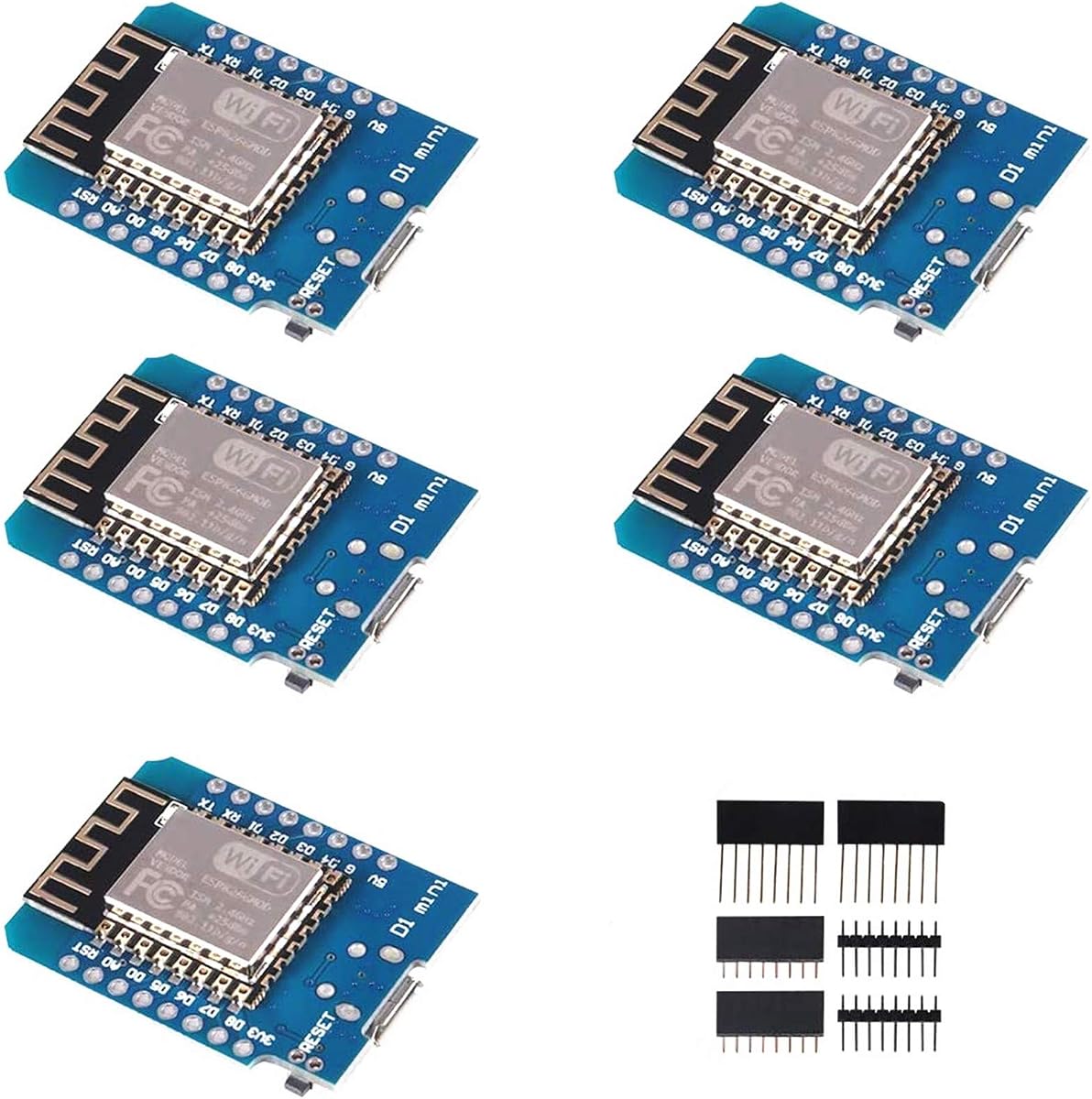
This bundle offers five mini D1 boards that are compatible with Arduino and WeMos platforms. They feature a compact design ideal for wearable electronics and portable devices.
We may earn a commission when you buy through this link, at no additional cost to you.
The boards include 11 digital input and output pins allowing for versatile sensor connections. They run on Lua and support 4M Bytes of flash memory for storing application data.
Since they rely on Micro USB connections they are easy to interface with computers for programming. However the small size means you must handle them carefully to avoid bent pins.
This is a great option for makers looking for a compact and capable WiFi board. If you need a small form factor with plenty of GPIO pins these boards are suitable.
The 11 digital pins provide ample room for connecting multiple sensors and actuators simultaneously.
The mini size makes these boards perfect for fitting into tight spaces in wearable electronics.
We may earn a commission when you buy through this link, at no additional cost to you.
This ten-pack provides a substantial supply of ESP8266 modules ideal for large scale testing or bulk deployment. They boast robust on-board processing capabilities for complex tasks and algorithms.
We may earn a commission when you buy through this link, at no additional cost to you.
The modules support LWIP in AP+STA mode which streamlines network development significantly. This flexibility allows for versatile networking options in diverse application scenarios.
While the modules are compact their size often demands precise soldering to ensure reliable connections. Proper handling and attention to voltage levels are essential to maintain their performance.
It is an excellent choice for educators or businesses needing a large inventory of modules. If you require reliable wireless transceivers in bulk this pack offers high value and consistency.
The on-board processor handles efficient execution of algorithms ensuring smooth data processing.
Support for multiple modes enables dynamic configuration for different IoT use cases.
We may earn a commission when you buy through this link, at no additional cost to you.
Selecting the right WiFi module depends on your specific project needs and technical requirements. This section outlines key factors to consider before making your purchase.
Consider the microcontroller capabilities required for your application. Dual-core options offer better performance for complex tasks.
Higher processing power ensures smooth handling of wireless data and real-time operations.
Check if the module supports WiFi only or both WiFi and Bluetooth. Bluetooth adds flexibility for direct device pairing.
Choose the connectivity type that matches your communication needs.
Verify the voltage needs of the module to prevent damage. Most ESP modules run on 3.3V requiring a voltage regulator.
Ensure your power source matches the module specifications for stable operation.
Look for modules with ample flash memory to store code and data. Higher memory capacity allows for larger web servers.
Select a module with enough storage to support your project size.
Decide between compact modules needing soldering or boards with headers. Larger boards are easier to prototype with.
Choose a size that fits your enclosure and prototyping tools.
Ensure the module supports the protocols you need like LWIP or AT commands. Proper protocol support simplifies coding.
Confirm compatibility with your chosen development environment and libraries.
Compare prices across different pack sizes to find the best value. Bulk packs often reduce the cost per unit.
Balance the features you need with your overall project budget.
Look for boards that support Over-the-Air updates for future firmware changes. This feature simplifies maintenance and improvements.
Prioritize modules that allow for easy updates without physical access.
Connect the module to a USB-to-Serial adapter if it lacks a direct USB port to upload code securely.
Ensure voltage levels match the module requirements to prevent overheating or permanent hardware damage.
Keep the antenna area clear of obstructions for optimal signal strength and reliable communication range.
The ESP32 offers dual-core processing and Bluetooth capability while the ESP8266 is single-core and WiFi only. Both are widely used for Arduino projects but ESP32 provides better performance for complex applications.
Yes usually you need a breakout board because the ESP01 module is very small and difficult to connect directly. Breakout boards provide easier access to the pins for prototyping and programming.
No most ESP modules operate on 3.3V so applying 5V will damage them. Use a voltage regulator to step down the power from your source.
You upload code using the Arduino IDE by selecting the correct board and serial port. You may need a USB-to-Serial adapter if the module lacks native USB support.
Most boards support C++ via Arduino IDE but newer models like the Nano ESP32 support MicroPython. Choose the language that fits your coding experience.
No these standard modules are not waterproof and should be kept in dry enclosures. For outdoor use use a protective case or conformal coating.
We have reviewed ten top options ranging from the powerful Arduino UNO R4 WiFi to budget-friendly ESP8266 packs. Each offers unique benefits depending on your project complexity.
Prioritize features like processing power and connectivity type to ensure your device meets performance needs. Consider the ease of integration for smoother development.
Always check current prices and availability before purchasing to get the best deal. With the right module your IoT projects can connect to the world effortlessly.