
Arduino UNO R3 Board
4.0Editor score
ATmega328P microcontroller at 16MHz
14 digital and 6 analog I/O pins
Standard USB connectivity for easy programming
This guide compares the best Arduino Uno Q boards and kits for 2026, covering hybrid processing, AI capabilities, and essential accessories for makers.
The Arduino Uno Q represents a significant leap forward in embedded development, blending traditional microcontroller simplicity with powerful single-board computer capabilities. This hybrid approach allows users to run complex AI models and Linux operating systems while maintaining real-time control for robotics and IoT applications.
We evaluated ten top-rated products including official boards, starter kits, and compatible accessories to help you find the right solution. Our analysis focuses on performance metrics, connectivity options, ecosystem compatibility, and value for money across different use cases and skill levels.
Each recommendation highlights specific strengths and limitations to guide your purchase decision based on your project requirements. Note that pricing and availability fluctuate frequently so always verify current details before finalizing your order through the provided links.
4.0Editor score

4.4Editor score
3.7Editor score
The following table provides a side-by-side comparison of all ten products analyzed in this guide. Each entry includes key specifications and direct links to detailed product pages on Amazon for further exploration and purchasing options.


The Arduino UNO Q 4GB stands out as a revolutionary hybrid board merging microcontroller reliability with single-board computer power. It holds a strong rating and introduces dual-brain processing for advanced AI and IoT tasks.
We may earn a commission when you buy through this link, at no additional cost to you.
Its standout quality lies in the Qualcomm Dragonwing QRB2210 MPU paired with an STM32U585 MCU enabling complex tasks like object recognition and voice commands. The 4GB RAM and 32GB storage allow it to run Linux Debian smoothly.
While the price reflects these premium features the learning curve for Linux might challenge pure beginners. However the unified development experience in Python and Sketches makes it worth the investment for serious developers.
Buyers looking for future-proofing and AI integration will find this board ideal. It empowers innovators to mix containerized models with traditional Arduino code in one interface seamlessly.
Combining MPU and MCU allows simultaneous real-time control and high-level AI processing without external components.
Maintains classic UNO shield compatibility while adding modern connectivity like USB-C and Wi-Fi 5.
We may earn a commission when you buy through this link, at no additional cost to you.
This kit offers the same powerful UNO Q 4GB board but bundles it with a dedicated 45W USB-C power supply ensuring stable operation. It targets professionals needing reliable power for heavy workloads.
We may earn a commission when you buy through this link, at no additional cost to you.
The inclusion of the power supply solves a common issue for edge AI users needing consistent voltage during intensive tasks. This makes it ideal for robotics and automation projects requiring uninterrupted performance.
Developers should note that while powerful it requires understanding Linux and hybrid architectures. The lack of extra peripherals means you may need to buy additional sensors separately for full functionality.
Choose this if you need a turnkey solution for advanced projects. The regulated power ensures your AI models run smoothly without unexpected shutdowns.
The 45W supply handles high power draw during AI processing ensuring system stability under stress.
Engineers can deploy this directly in scalable systems without worrying about power adapter compatibility.
We may earn a commission when you buy through this link, at no additional cost to you.
The GeeekPi Starter Kit provides everything needed to turn the UNO Q into a desktop computer. It includes an aluminum case, USB-C hub, and all necessary cables for immediate setup and use.
We may earn a commission when you buy through this link, at no additional cost to you.
Users praise the comprehensive nature of this kit as it removes the guesswork of sourcing peripherals. The aluminum case offers physical protection and heat dissipation which is vital for long running sessions.
However the 2GB RAM and 16GB storage may limit complex AI training tasks compared to the 4GB version. For general embedded development and basic AI it remains a strong value proposition.
Ideal for educators and students needing a plug-and-play experience. It simplifies the learning curve by providing a ready-to-run environment right out of the box.
The aluminum housing shields the board from static and impacts while aiding heat dissipation during intensive tasks.
The included hub adds Ethernet support enabling wired network connections for more stable IoT deployments.
We may earn a commission when you buy through this link, at no additional cost to you.
The Uno REV3 remains a staple in educational environments and prototyping. It holds a very high rating and provides the foundational experience for anyone learning electronics and C++ coding.
We may earn a commission when you buy through this link, at no additional cost to you.
Its strength is simplicity and reliability. With 14 digital pins and 6 analog inputs it handles standard sensor readings and motor control perfectly without the complexity of modern hybrid systems.
For users seeking Linux or AI capabilities this board is insufficient. It lacks the processing power for complex algorithms but excels at real-time control and logic.
Perfect for STEM classrooms and hobbyists starting from scratch. It ensures a smooth learning curve before transitioning to more advanced boards like the UNO Q.
This board is the standard tool for learning embedded electronics ensuring students understand core concepts first.
Full compatibility with the Arduino IDE provides access to vast libraries and community code examples.
We may earn a commission when you buy through this link, at no additional cost to you.
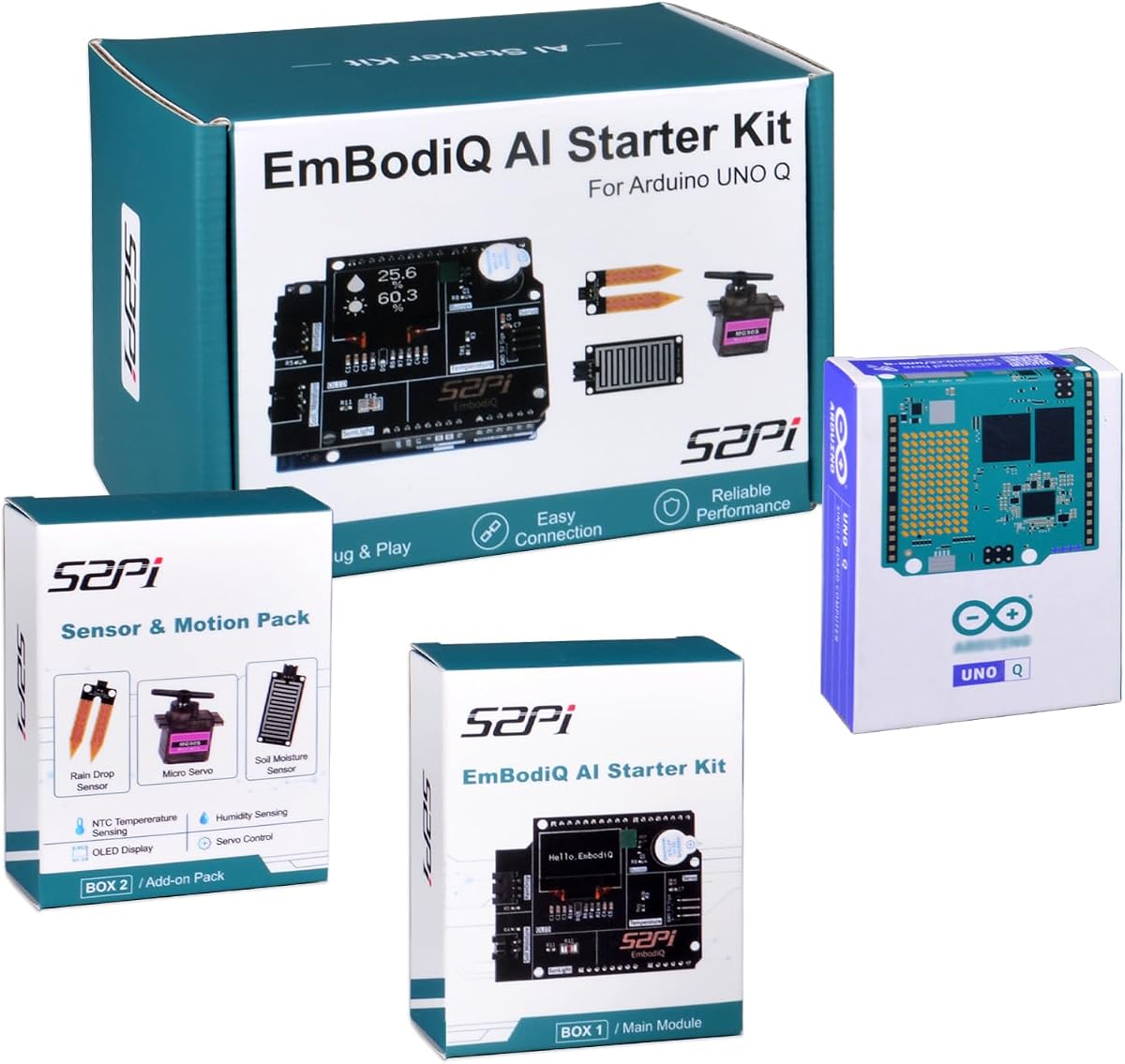
This kit is unique because it focuses on natural language control allowing users to command hardware with text or voice. It uses the EmbodiQ AI Agent to interpret commands and execute tasks.
We may earn a commission when you buy through this link, at no additional cost to you.
It supports various AI providers like OpenAI giving flexibility on which models to use. This is perfect for smart gardening or weather stations where complex coding should be minimized.
The lower rating suggests setup may be tricky for some users. It requires understanding the AI interface and configuring the API keys correctly to function as intended.
Ideal for makers who want to experiment with AI agents without deep coding. It simplifies the interaction between humans and physical hardware significantly.
Natural language processing allows intuitive control of motors and sensors through simple text commands.
Users can switch between different AI models via a web interface to fit specific project needs.
We may earn a commission when you buy through this link, at no additional cost to you.
The UNO R4 WiFi brings wireless capabilities and modern connectivity to the classic form factor. It has a very high rating and is widely regarded as the successor to the R3 for IoT.
We may earn a commission when you buy through this link, at no additional cost to you.
Its dual-core processing combines a Renesas microcontroller with an ESP32-S3 chip for stable wireless communication. The 12-bit DAC allows for high-quality audio and sensor signal processing.
While it lacks the heavy AI capabilities of the UNO Q it is more accessible for standard smart home projects. The built-in LED matrix offers instant visual feedback without extra components.
Recommended for general IoT projects needing Wi-Fi without Linux complexity. It strikes a great balance between cost and modern functionality for most hobbyists.
The 12-bit DAC and OP-AMP enable precise analog signal generation for audio and sensor applications.
The integrated LED matrix allows displaying messages and data directly on the board without external screens.
We may earn a commission when you buy through this link, at no additional cost to you.
The ELEGOO UNO R3 Kit is the gold standard for learning. It includes a full range of components and tutorials ensuring beginners can start building immediately without extra purchases.
We may earn a commission when you buy through this link, at no additional cost to you.
The kit focuses on guided learning with lessons on motors, sensors, and displays. It helps users understand the logic of electronics and programming before creating their own designs.
While the hardware is standard R3 the value lies in the structured educational content. This makes it excellent for homeschooling or STEM clubs needing a complete curriculum.
Perfect for students and parents wanting a family build project. It removes the frustration of sourcing missing parts and provides clear step-by-step instructions.
Guided lessons walk users through basic concepts to intermediate projects ensuring a smooth educational progression.
Includes motors, sensors, and displays to demonstrate real-world applications of embedded programming.
We may earn a commission when you buy through this link, at no additional cost to you.
This board provides a compatible alternative for users needing a standard microcontroller without the official price tag. It holds a strong rating and works seamlessly with existing Arduino libraries.
We may earn a commission when you buy through this link, at no additional cost to you.
It is identical in function to the official Uno but costs less. This makes it ideal for bulk projects or when multiple boards are needed for a classroom or lab.
Users should be aware that while compatible it does not offer the advanced features of newer boards like the R4 or Q. It is a solid choice for foundational electronics.
Choose this for cost-effective prototyping where budget is a primary concern. It offers the same results for basic projects without financial overhead.
Designed to work exactly like the official board ensuring all existing shields and code run without issues.
Provides high reliability and full functionality at a significantly lower price point than original hardware.
We may earn a commission when you buy through this link, at no additional cost to you.
This board is a straightforward entry point into the Arduino ecosystem. It includes the basic components needed to start coding and building simple circuits immediately.
We may earn a commission when you buy through this link, at no additional cost to you.
The inclusion of the USB cable makes it ready to plug into a computer right away. It supports standard protocols like I2C and SPI for connecting various modules.
While it is a basic option it is sufficient for learning the fundamentals of microcontrollers. The rating reflects its utility as a reliable tool for students and beginners.
Recommended for first-time builders on a tight budget. It offers a clean and direct path to understanding electronic interfaces and programming logic.
Standard communication protocols ensure compatibility with a wide range of sensors and display modules.
Includes necessary USB cable so users can begin programming immediately without extra accessories.
We may earn a commission when you buy through this link, at no additional cost to you.
This board is a generic clone designed for cost efficiency. It maintains compatibility with standard Arduino shields and allows control of devices across different platforms like Raspberry Pi.
We may earn a commission when you buy through this link, at no additional cost to you.
Its value lies in the low price and broad compatibility making it suitable for projects where multiple boards are needed. It supports PWM for motor and LED control effectively.
Users should expect basic performance without premium build quality. However for prototyping and educational use it offers a robust and inexpensive solution.
Ideal for bulk deployments or budget-constrained projects. It ensures you can scale your electronics work without significant financial investment.
Compatible with various platforms allowing integration into mixed hardware systems for versatile project designs.
Provides functional microcontroller capabilities at a price point suitable for large scale or repetitive builds.
We may earn a commission when you buy through this link, at no additional cost to you.
Selecting the right board requires balancing performance needs with budget and project complexity. This guide outlines the key factors to consider before making a decision.
The UNO Q uses a hybrid architecture combining a powerful ARM processor with a microcontroller. This is essential for AI tasks but overkill for simple blink tests.
Choose hybrid boards only if you need machine learning or Linux support otherwise stick to standard microcontrollers.
RAM and storage sizes vary significantly between models. 4GB RAM allows multitasking and AI model storage whereas 2GB is sufficient for basic scripts.
Prioritize larger storage if you plan to run complex models or keep detailed logs locally.
Wireless capabilities like Wi-Fi and Bluetooth are critical for IoT projects. The R4 WiFi and UNO Q both offer robust wireless options for remote control.
Ensure your chosen board supports the communication protocols your project requires like I2C or SPI.
Linux support on the UNO Q opens doors to Python and modern apps. Traditional boards like the R3 rely on C++ code only.
If you prefer Python or want a desktop-like interface look for Linux capable boards.
Advanced boards like the UNO Q require stable and higher power supplies. Ensure you have access to a 45W USB-C supply for reliable operation.
Standard boards run easily on USB power but check voltage limits for external supplies.
Starter kits often include cases and cables which save time and money. The GeeekPi kits are examples of complete solutions ready for use.
Buying a bare board requires sourcing cables and power adapters separately.
Shield compatibility ensures you can use existing add-ons. The classic UNO form factor supports most traditional shields.
Verify that new features like Wi-Fi do not block critical pin connections.
Beginners should consider the learning curve associated with Linux and hybrid architectures. Standard boards have more resources for basic tasks.
Select a board that matches your current coding skills to avoid frustration.
Start by connecting the board to your computer via USB-C. Install the necessary drivers and launch the Arduino IDE or your preferred development environment to begin writing code.
If using Linux features ensure you have the correct image installed and follow the setup guide to configure network settings. This allows access to terminal commands and package management.
Store your board in a dry and static-free environment when not in use. Use the aluminum case if provided to prevent dust accumulation and physical damage.
Yes the Arduino Uno Q supports Python scripts alongside traditional Arduino Sketches. This allows for complex AI applications and easier logic handling for developers familiar with Python.
The UNO Q has a hybrid CPU and MCU architecture supporting Linux and 4GB RAM. The R4 is a standard microcontroller with Wi-Fi but no Linux support or large memory capacity.
The UNO Q retains the classic UNO form factor making it compatible with most standard shields. However check that the headers align correctly for specific add-ons.
Yes for the UNO Q you should use a 45W USB-C power supply to ensure stable operation during high load tasks. Standard USB ports may not provide enough power.
The UNO Q is excellent for robotics as it combines real-time control with AI vision and processing capabilities. This makes it suitable for autonomous navigation and object recognition.
Firmware updates can be managed through the Arduino App Lab or via the Linux terminal depending on your use case. Always back up your projects before updating.
Linux Debian offers a familiar terminal environment for programmers. It may require basic setup knowledge but simplifies file management and script execution.
The UNO Q supports a wide range of sensors via I2C and SPI. It also has specific interfaces for cameras and audio input enabling vision and voice projects.
The Arduino Uno Q series offers powerful hybrid capabilities for advanced projects while the R3 options remain solid for beginners. We recommend the UNO Q 4GB for those needing AI features.
Prioritize your project requirements like processing power and connectivity before buying. Kits with cases and power supplies provide the best value for immediate deployment.
Always check current prices and availability on Amazon as they change frequently. Use the links provided to access the latest product details and customer reviews.