
HiLetgo ENC28J60 Ethernet LAN Network Module
4.3Editor score
Low power consumption design
25MHz crystal oscillator included
Affordable entry-level option
This guide compares the top Arduino Lan Ethernet Module options for reliable connectivity, covering W5500, W5100, and ENC28J60 chips for various microcontroller
Connecting your Arduino projects to the internet opens up a world of possibilities for data logging, remote control, and IoT applications. An Arduino Lan Ethernet Module provides the necessary hardware bridge to achieve this connectivity without relying on wireless signals that may be unstable.
We have evaluated ten distinct modules based on their chip architecture, interface speed, power requirements, and compatibility with popular development boards. This analysis helps you understand the trade-offs between newer W5500 chips and legacy options like the ENC28J60 or W5100.
Each pick below details specific technical capabilities and real-world performance expectations to guide your selection process. Please note that availability and pricing can change frequently, so verifying current stock before ordering is always recommended for your project timeline.
4.3Editor score

4.2Editor score
5.0Editor score
The following table provides a side-by-side technical comparison of all ten modules to help you identify the specific features that matter most for your application.



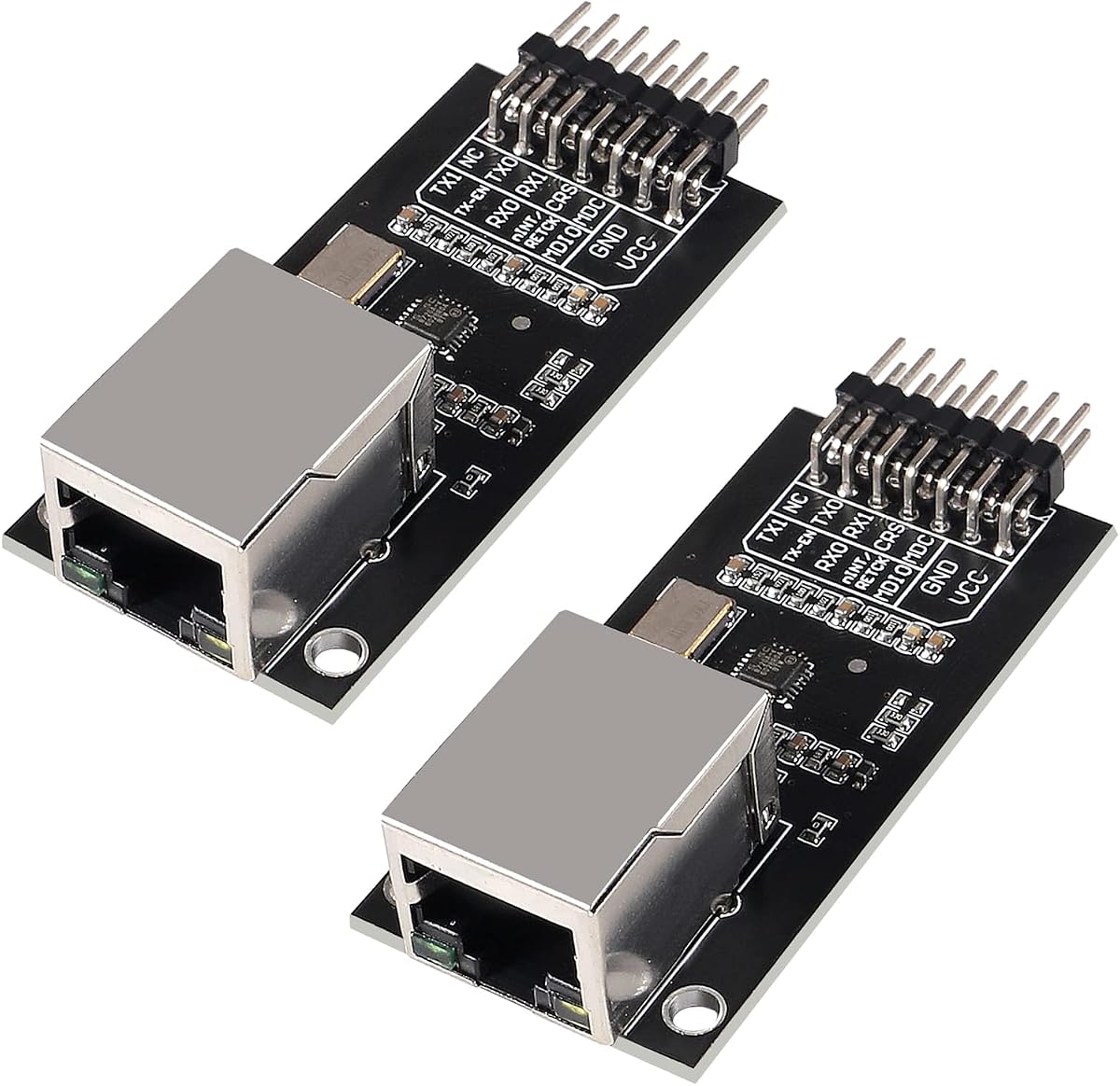

This HiLetgo module stands out as a top contender for developers needing robust Ethernet connectivity. It features the W5500 chip which offers significant improvements over older generations. The package includes two units, making it ideal for prototyping multiple devices at once without buying separate packs.
We may earn a commission when you buy through this link, at no additional cost to you.
The W5500 chip supports eight independent sockets simultaneously, allowing your project to maintain multiple network connections at the same time. It also includes a built-in 32KB memory buffer for TX and RX data which reduces the load on your microcontroller. This makes it particularly suitable for data intensive applications like web servers or streaming.
While the performance is excellent, the SPI interface requires careful wiring to ensure stability at high clock speeds. Some users may need to adjust their code to handle interrupts properly for best results. These are minor trade-offs given the advanced capabilities provided by the hardware.
This module is best for hobbyists and professionals who need a reliable Ethernet solution for Arduino or STM32 projects. It offers a great balance of performance and cost especially when buying the two pack version.
The ability to handle eight simultaneous sockets allows for complex network operations without blocking the main processor.
Internal memory buffers help manage data flow efficiently preventing packet loss during high traffic periods.
We may earn a commission when you buy through this link, at no additional cost to you.
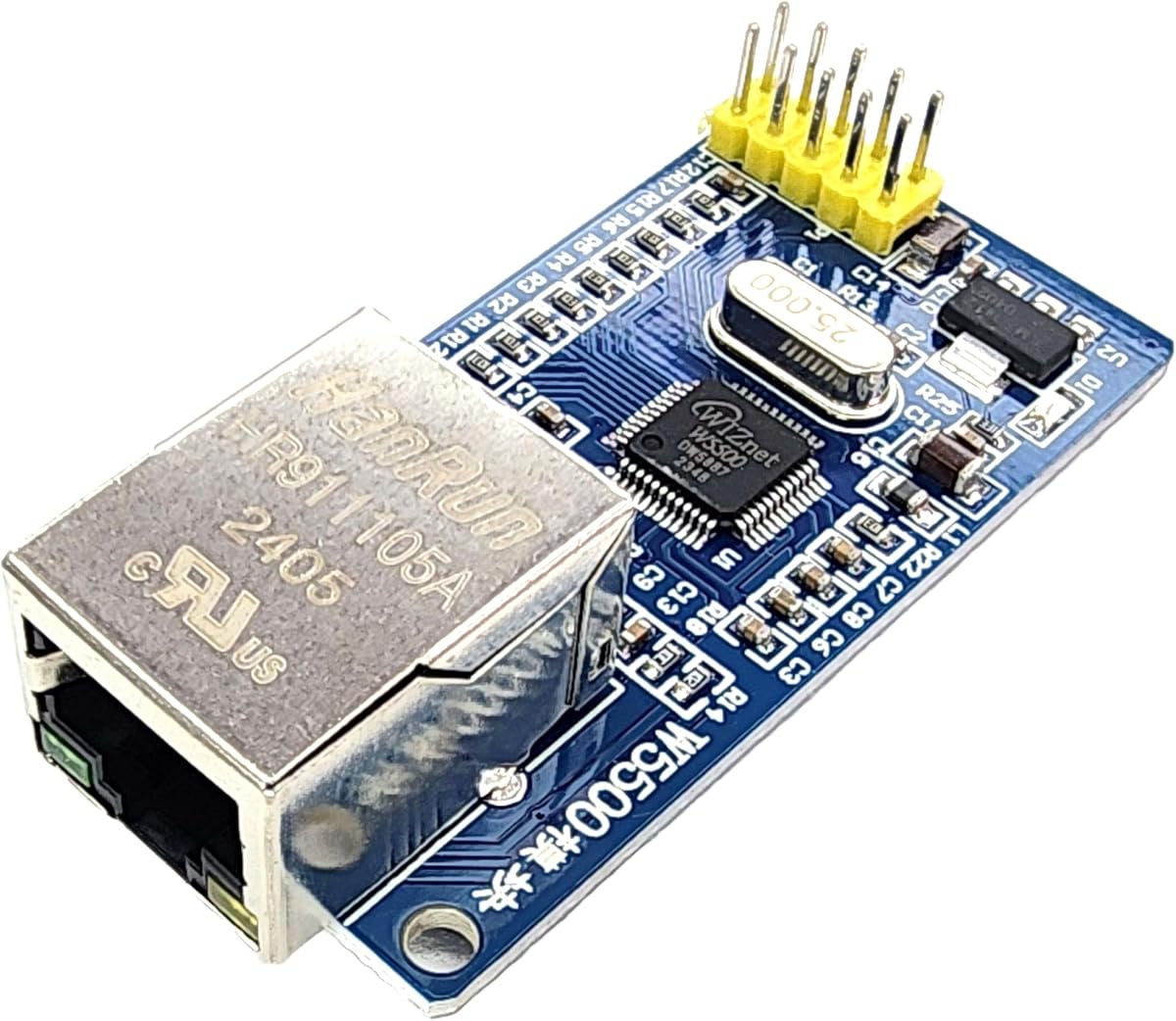
This single unit offers the same powerful W5500 chip found in the multi-pack options but in a standalone format. It is designed for easy integration with SPI enabled microcontrollers. Users appreciate its compact size which fits well on small breadboards or custom enclosures.
We may earn a commission when you buy through this link, at no additional cost to you.
The module supports TCP IP protocols natively which simplifies software development for internet connected applications. It operates on a 3.3V power supply ensuring compatibility with modern logic levels. The SPI interface allows for fast data transfer rates suitable for real-time projects.
Power stability is critical for this module as fluctuations can cause connection drops. Ensuring your power source can deliver at least 200mA is essential for consistent performance. This requirement might necessitate a separate power rail for battery powered projects.
Ideal for users who need one reliable Ethernet interface for a specific project. It provides a straightforward path to wired networking without the complexity of additional shields.
The small PCB footprint saves space on your project allowing room for other components on the board.
Native TCP IP support means you can write standard network code without needing heavy middleware libraries.
We may earn a commission when you buy through this link, at no additional cost to you.
This five-pack from ACEIRMC provides an economical way to stock up on high performance Ethernet modules. Each unit features the W5500 chip ensuring consistent quality across the batch. It is a great choice for classrooms or businesses deploying multiple connected devices.
We may earn a commission when you buy through this link, at no additional cost to you.
The module supports 3.3V logic and integrates seamlessly with SPI buses. Its physical dimensions are compact at 23 by 25 millimeters making it easy to mount. The inclusion of multiple units reduces the risk of running out during production or experimentation.
Stable power delivery remains a key requirement for reliable operation. Users should ensure their 3.3V source is clean and capable of handling the current demand. Proper decoupling capacitors can help mitigate noise issues on long wires.
This bulk option is perfect for prototyping fleets of devices or educational settings where several students need their own modules. It balances cost and performance effectively for large scale deployments.
Having five units on hand allows you to test multiple configurations simultaneously without waiting for shipments.
Using the standard SPI interface ensures compatibility with almost any microcontroller board available on the market.
We may earn a commission when you buy through this link, at no additional cost to you.
This 2-pack features the W5500 chip with support for high speed SPI modes up to 80MHz. It includes hardware TCP/IP stack integration which offloads processing tasks from your microcontroller. The package offers strong technical specs for real-time control scenarios.
We may earn a commission when you buy through this link, at no additional cost to you.
The embedded 10/100Mbps Ethernet PHY with auto-negotiation ensures compatibility with various network speeds. It manages eight simultaneous sockets and supports Wake-on-LAN via UDP protocols. The 32KB TX/RX buffers provide ample space for data caching.
However the low rating suggests potential quality control or compatibility issues in the field. Users might encounter difficulties with initialization or power stability. Careful selection and testing are recommended before deploying in critical applications.
For those who can verify the units upon arrival this offers a powerful solution for high bandwidth needs. It is best suited for experienced users who can troubleshoot hardware quirks effectively.
Support for 80MHz SPI modes enables faster data transfer rates for demanding applications.
Integrated TCP/IP stack reduces software overhead allowing more focus on application logic.
We may earn a commission when you buy through this link, at no additional cost to you.
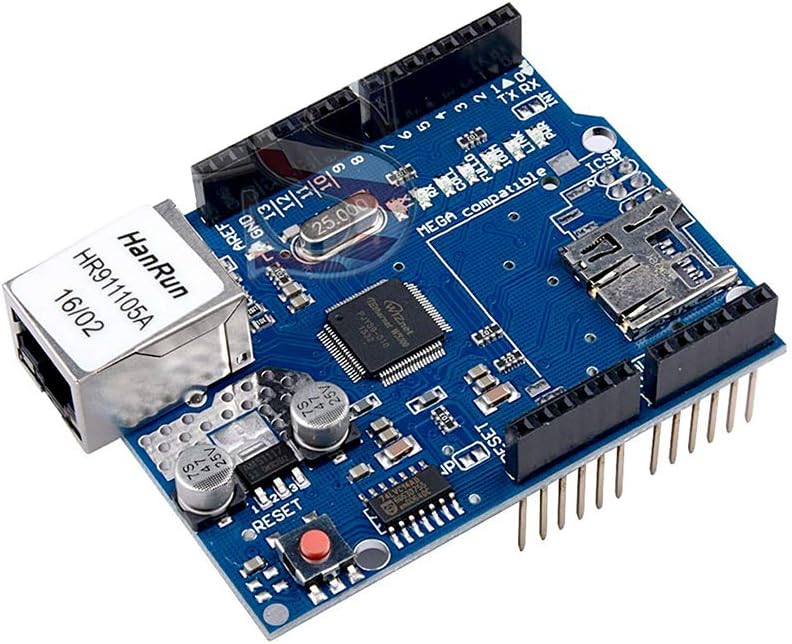
This shield format allows you to stack Ethernet capability directly on top of an Arduino board. It uses the W5100 chip which is a well established solution for network connectivity. The added SD card slot enables local storage of data without external hardware.
We may earn a commission when you buy through this link, at no additional cost to you.
Connectivity is handled via a standard RJ45 jack making cabling simple and robust. It works with UNO R3 and Mega boards providing a familiar interface for many users. The TCP and UDP stack is integrated into the hardware for reliable communication.
The larger size can be a drawback for compact projects where space is limited. It also draws more power than smaller SPI modules which affects battery life. Wiring is simplified as it plugs directly into the headers.
Best for projects that benefit from stacking form factors and local storage needs. It is a solid choice for those already comfortable with shield based expansion.
The shield plugs directly into Arduino headers saving pin usage and simplifying the build process.
Integrated SD card support allows logging data locally without needing external memory modules.
We may earn a commission when you buy through this link, at no additional cost to you.
The ENC28J60 module is a classic choice for those looking to add Ethernet at the lowest possible cost. It relies on the ENC28J60 chip which has been around for many years. It includes the necessary 25MHz crystal for stable timing.
We may earn a commission when you buy through this link, at no additional cost to you.
Power consumption is low making it suitable for battery powered applications. The module supports a wide range of microcontrollers including AVR and STM32. Wiring is straightforward using the standard SPI pins available on most boards.
Performance is not as high as the W5500 options with lower throughput speeds. It may struggle in electrically noisy environments without additional filtering. For basic data logging though it is often sufficient.
This is the go-to pick for tight budgets or simple static sensor projects. It provides basic connectivity without breaking the bank.
Pricing is among the lowest in the category making it accessible for students and budget constrained projects.
Support for multiple microcontroller families ensures you can use it with almost any board you have.
We may earn a commission when you buy through this link, at no additional cost to you.
This five-pack of ENC28J60 modules offers a high volume solution at a very low price point. It has received strong ratings from users who appreciate its reliability for simple tasks. The design is identical to other ENC28J60 boards ensuring standard libraries will work.
We may earn a commission when you buy through this link, at no additional cost to you.
The 3.3V operation and SPI interface make integration simple for most boards. It uses the same transformer and crystal configuration found in other similar modules. This consistency helps in debugging and code reuse across multiple units.
Speed is a limitation as this chip is designed for basic connectivity not high throughput. It is best used for sending small sensor readings rather than large file transfers. Power usage remains low which is beneficial for energy efficiency.
Ideal for educational kits or large scale sensor networks where individual node cost matters most. It provides the necessary connectivity to keep costs down while maintaining decent performance.
Purchasing five units together significantly reduces the per unit cost compared to single buys.
The ENC28J60 has been used in many projects for years ensuring broad software support and documentation.
We may earn a commission when you buy through this link, at no additional cost to you.
This module stands out with a perfect rating from users who value ease of use and reliability. It features a full-size RJ45 port which simplifies connection to network switches. The support for both 5V and 3.3V boards increases flexibility.
We may earn a commission when you buy through this link, at no additional cost to you.
The product page includes links to tutorials which helps beginners get started quickly. It uses the robust W5500 chip ensuring stable TCP and UDP communication. The SPI interface is straightforward to implement with standard libraries.
Since it is sold as a single unit it might be less economical than bulk options. However the user experience and support materials add value for those new to networking. It minimizes the trial and error often associated with hardware integration.
Best for first time users or those needing a guaranteed working solution without extra research. It delivers a premium experience in a simple and reliable package.
The availability of online tutorials reduces the learning curve for setting up network connections.
Support for Arduino and ESP boards means you can use it with almost any common microcontroller.
We may earn a commission when you buy through this link, at no additional cost to you.
The LAN8720 is a high performance physical layer transceiver designed for robust network communication. It supports Auto-MDIX which automatically detects the correct cable type without manual crossover configuration. This feature simplifies physical wiring significantly.
We may earn a commission when you buy through this link, at no additional cost to you.
The module is powered by a single 3.3V supply making it efficient for modern logic systems. It includes an internal regulator to handle voltage conversion for IO lines. The design allows for flexible power management suitable for battery systems.
Integration can be more complex than standard W5500 modules as it often requires specific drivers. Software support might not be as universal across all Arduino libraries. It is better suited for advanced users familiar with network stacks.
Choose this module if you need specific PHY features like Auto-MDIX in your design. It is ideal for professional applications where hardware control is prioritized.
This feature eliminates the need to worry about using straight-through or crossover cables.
The design is optimized for low power consumption helping extend battery life in portable projects.
We may earn a commission when you buy through this link, at no additional cost to you.
This module offers a reliable version of the ENC28J60 interface with high user satisfaction. It features the DIP28 chip which is easy to identify and replace if needed. The 25MHz crystal ensures stable clock rates for communication.
We may earn a commission when you buy through this link, at no additional cost to you.
Compatibility with 51 AVR LPC and STM32 microcontrollers makes it a versatile choice. The RJ45 connector includes a transformer for signal isolation. It fits well into existing projects that use the ENC28J60 library.
While it does not offer the speed of newer chips it provides consistent performance for its class. It is a safe choice when standard libraries are preferred over newer custom stacks. The packaging and build quality are generally rated highly.
This is a solid pick for those who prefer a proven design over the latest technology. It works well for simple IoT tasks where speed is not the primary concern.
The use of a standard DIP chip makes it easy to identify and replace if necessary.
Support for multiple MCU families means you can reuse the hardware across different projects.
We may earn a commission when you buy through this link, at no additional cost to you.
Selecting the right Ethernet module depends on your project's power requirements speed needs and compatibility with your microcontroller.
The chipset determines the speed and reliability of your network connection. Newer chips like the W5500 offer hardware TCP/IP stacks and faster SPI interfaces compared to older chips like the ENC28J60. These features reduce the load on your microcontroller and allow for more complex networking tasks.
Choose a chipset that matches the processing power of your project to avoid bottlenecks during data transfer.
Most modules use the SPI interface which is standard on many boards like Arduino Uno. Ensure your microcontroller supports the specific SPI mode required by the module. Some modules also offer 5V tolerance which is helpful if your board runs at higher voltages.
Verify the voltage levels and SPI mode compatibility before buying to ensure a smooth connection.
Different modules have different current demands. Some require a stable 3.3V source capable of delivering at least 200mA. If your board cannot supply this current you may need an external power regulator to prevent connection drops.
Check the current rating of your microcontroller's 3.3V pin and match it to the module's needs.
Advanced modules like the W5500 support multiple simultaneous sockets allowing for more complex network operations. Basic modules might be limited to fewer connections or require software multitasking to handle multiple streams.
If your project involves handling several connections at once ensure the hardware supports multiple sockets.
Modules come in various sizes including compact boards and larger shields. Shields plug directly into the board headers saving space and wiring but take up more room. Compact modules are better for enclosed projects where space is limited.
Measure your project space and consider whether a shield or module fits your enclosure better.
Ensure the module supports the necessary protocols like TCP UDP or HTTP for your application. Hardware stacks are more efficient than software implementations on the microcontroller. This distinction is critical for real time applications.
Look for modules with built in protocol support to simplify your software development process.
Good documentation and library support are essential for easy integration. Modules with active communities and sample code can save hours of troubleshooting. Check online forums to see if others have successfully used the module with your board.
Select a product with clear documentation and examples to avoid development delays.
Buying in bulk often reduces the per unit cost and is useful for production runs. However single unit purchases are better for testing a new technology. Evaluate your project scale before deciding on a bulk or single unit purchase.
Balance your budget and testing needs to choose the best quantity option.
Connect the module to your microcontroller using the appropriate SPI pins such as MOSI MISO CS and SCK. Ensure the voltage levels match by using level shifters if your board is 5V and the module is 3.3V. Use a reliable Ethernet cable to connect the module to your router or switch.
Power the module using a stable source that can provide the required current to prevent intermittent connections. Add capacitors near the power pins if you experience noise issues to smooth out the voltage. Keep cables away from high power lines to reduce electromagnetic interference.
Install the necessary library for your module in your development environment to handle network protocols efficiently. Test the connection using a simple sketch that checks for IP assignment. Regularly check your network status to ensure the module maintains its connection over time.
The W5500 chip offers better performance with hardware TCP/IP stack and higher speed SPI interface. It also supports more simultaneous sockets compared to the older W5100. The W5500 is generally more efficient for modern projects requiring complex networking.
Yes most modules support Arduino Uno via the SPI interface. You may need to manage voltage levels since Uno is 5V while some modules are 3.3V. Using a level shifter ensures safe communication between the board and the module.
It depends on the module and your board. Some modules need more current than the Arduino 3.3V pin can provide. If the module specifies 200mA or more check your board capacity. Use an external supply if the board cannot deliver enough current.
Check your wiring connections and ensure the SPI pins are correctly linked. Verify that the IP address is assigned correctly by your router. Ensure the Ethernet cable is functional by testing it with another device to rule out physical issues.
Modules with 3.3V logic like the W5500 are ideal for ESP32 since both run on 3.3V. These avoid the need for level shifters and simplify the hardware setup. Ensure the SPI speed supported by the module matches the ESP32 capabilities.
Yes many modules explicitly state compatibility with STM32 microcontrollers. Check the voltage levels and SPI configuration to match your specific STM32 board. Libraries available for STM32 support these Ethernet modules effectively.
The HiLetgo W5500 two-pack offers a strong balance of performance and value for most users. For tight budgets the ENC28J60 options provide basic connectivity at a low cost. Single units with full support like the W5500 RJ45 module are great for beginners.
Consider your project requirements carefully to decide which chip and form factor best suit your needs. Prioritize power stability and library support to ensure your network application runs smoothly. Avoid skipping voltage checks to prevent damage to your microcontroller.
Always verify the current stock and pricing before placing your order as these details can change frequently. Selecting the right module sets a solid foundation for your connected project success.