
Behringer RHYTHM DESIGNER RD-8
4.6Editor score
Authentic analog sound engine
16 drum sounds included
64 step sequencer support
Explore our expert guide comparing the top 808 drum machines for 2026. We analyze features, sound quality, and workflow to help you choose the perfect rhythm
Finding the right 808 drum machine can transform your music production workflow. Whether you seek vintage analog warmth or modern digital flexibility, the market offers diverse options for every producer level and budget constraint.
We compared ten top-rated models based on sound engine quality, sequencing capabilities, and build durability. Our analysis focuses on how each unit handles classic TR sounds while integrating modern connectivity and performance features for live or studio use.
Each pick highlights specific strengths like portability, sound design depth, or professional output options. Note that pricing fluctuates based on availability and retailer promotions so always check current listings before making your final purchase decision.
4.6Editor score

4.6Editor score

5.0Editor score
This side-by-side comparison details the core specifications of each model including sound engine type, sequencer length, connectivity options, and unique features to help you visualize differences at a glance.



The Roland TR-08 stands as a premier choice for producers seeking the authentic TR-808 experience in a modern package. With a 4.6 star rating it delivers the iconic sound that defined genres without requiring the maintenance of vintage gear.
We may earn a commission when you buy through this link, at no additional cost to you.
Its standout qualities include ultra-compact form factor and retention of the original character. Hands-on controls for tone and tuning allow quick adjustments during live sets or studio sessions making it highly responsive.
While it carries a higher price compared to clones the sound authenticity justifies the investment. The lack of sample importing limits modern customization but preserves the focused workflow purists appreciate.
This machine is ideal for electronic producers and performers wanting classic analog warmth without compromise. It balances nostalgia with reliability making it a top recommendation for serious beatmakers.
The TR-08 uses Analog Circuit Behavior technology to faithfully reproduce the circuitry of the original unit ensuring every snare and kick hits with the expected punch and warmth.
Classic Step and Tap write modes enable users to input rhythms quickly allowing for both precise programming and spontaneous creation during improvisation.
We may earn a commission when you buy through this link, at no additional cost to you.
The TR-6S offers a powerful portable solution for creating beats on the go. Rated 4.6 stars it combines classic TR sounds with modern features like battery power and sample support making it versatile for travel.
We may earn a commission when you buy through this link, at no additional cost to you.
Key strengths include six tracks of advanced sequencing and a large preset sample library. The FM sound engine adds futuristic tones while the ability to mix and match sounds supports unique hybrid kit creation.
Trade-offs involve a steep learning curve for those new to advanced sequencers. The compact size might feel cramped for users with larger hands but the convenience often outweighs this minor ergonomic issue.
Beatmakers needing mobility will find this unit essential for their workflow. It bridges the gap between vintage inspiration and contemporary production needs effectively.
With detailed circuit models of iconic drums and an editable FM engine you can craft sounds ranging from classic to completely futuristic in a single device.
Acting as a high-quality USB audio and MIDI interface it integrates easily with computers and external gear simplifying your recording setup significantly.
We may earn a commission when you buy through this link, at no additional cost to you.
The Behringer RD-8 provides an entry point into authentic analog drum synthesis without breaking the bank. With a 4.6 rating it replicates the legendary 662 OTA chip for ultimate sound authenticity and performance.
We may earn a commission when you buy through this link, at no additional cost to you.
Its powerful 64-step sequencer supports poly-meter and real-time triggering features. The 11 independent analog outputs allow for external processing giving you studio flexibility typically reserved for much more expensive units.
While build quality can vary between units the sound engine remains impressive for the price. The lack of detailed documentation may challenge beginners but community forums often fill that gap.
For budget-conscious producers seeking genuine analog warmth this unit delivers exceptional value. It is perfect for those wanting to record multi-track rhythms without high costs.
The reproduction of specific vintage chips ensures the sound matches classic records closely satisfying audiophiles who demand true analog character in their beats.
Multiple outputs let you route each drum sound to separate channels enabling detailed mixing and effects processing that standard units cannot match easily.
We may earn a commission when you buy through this link, at no additional cost to you.
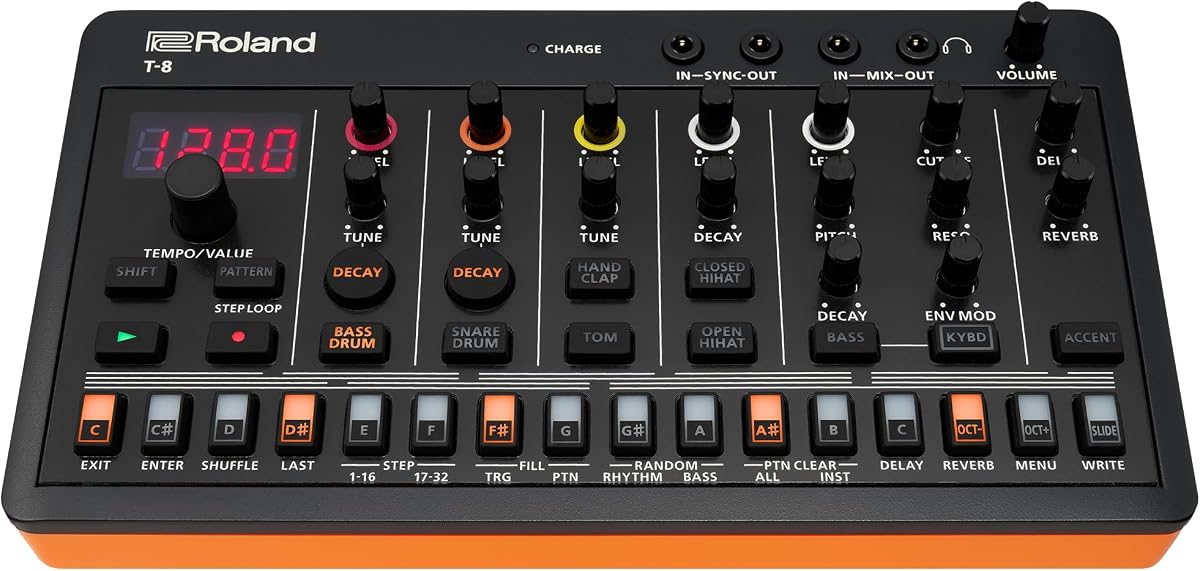
The T-8 puts legendary creative magic in the palm of your hand for jamming anywhere. Its 4.5 rating reflects user satisfaction with its ability to create infectious tracks quickly using pristine TR and TB sounds.
We may earn a commission when you buy through this link, at no additional cost to you.
Key strengths include the intuitive 16-step sequencer and probability features for dynamic patterns. Advanced rhythm programming like sub steps and velocity controls provide depth despite the small size.
Trade-offs include limited step counts compared to full-sized sequencers. The build is durable but minimal so extra care is needed during transport to prevent damage to controls.
Traveling performers or idea-focused users will love this unit. It encourages spontaneous creativity and keeps the fun in the flow with hands-on tools.
Features 64 user patterns with up to 32 steps each allowing extensive rhythm programming within a compact form factor that fits in any bag.
Color and process sounds with delay reverb and sidechain compression onboard saving you from needing extra gear for a polished final sound.
We may earn a commission when you buy through this link, at no additional cost to you.
The Behringer RD-9 focuses on sound design with its analog filter and wave features. Rated 4.5 stars it offers 11 sounds with parameters that allow deep shaping for unique rhythm textures.
We may earn a commission when you buy through this link, at no additional cost to you.
With 10 individual outputs it provides routing flexibility for mixing. The Wave Designer allows for custom tonal adjustments making it a powerful tool for producers wanting specific character.
Menu navigation can be complex for those unfamiliar with Behringer gear. Users should note that build consistency may vary so inspecting the unit upon arrival is recommended.
Sound designers needing analog depth should consider this option. It complements studios requiring detailed control over individual drum timbres effectively.
Wave Designer effects let you sculpt the attack and decay of instruments creating personalized sounds that stand out in a mix.
Individual outputs allow for external processing chains giving you full control over dynamics and EQ for each track separately.
We may earn a commission when you buy through this link, at no additional cost to you.
The TR-1000 is the deepest and most powerful drum machine ever created by Roland. With a perfect 5.0 rating it offers an analog engine with classic TR-808 and TR-909 sounds plus extensive new parameters.
We may earn a commission when you buy through this link, at no additional cost to you.
Key strengths include over 2000 onboard sounds and stereo sampling features. The next-generation TR-REC step sequencer with off-grid control and probability offers precise beat creation and dynamic live performance capabilities.
The high cost is a significant barrier for some users. The size and weight are substantial so it is best suited for dedicated studio spaces rather than portable setups.
Professional producers needing top-tier sound and routing should choose this unit. It represents the pinnacle of current drum machine technology and reliability.
With 46 GB of memory for user samples and non-destructive slice editing you can load and manipulate extensive libraries without limits.
Motion recording and dedicated layer tracks allow for detailed sound design and complex rhythmic patterns that evolve over time.
We may earn a commission when you buy through this link, at no additional cost to you.
The Behringer LM brings hybrid sampling to the table for modern producers seeking versatile sounds. Rated 4.4 stars it combines digital flexibility with traditional rhythmic control in a manageable form factor.
We may earn a commission when you buy through this link, at no additional cost to you.
Its hybrid nature allows for blending synthesized tones with recorded samples. This creates a broad palette for genres requiring both organic and digital textures effectively.
Limitations include constraints on sample size and management. Users may find the menu system less intuitive than dedicated sampling units but the core workflow remains robust.
Producers wanting a hybrid workflow without high costs will appreciate this model. It serves well for experimental music and versatile productions.
Hybrid capabilities let you merge analog warmth with digital samples giving you a wide range of tonal options in one device.
Despite its power it fits easily into desktop setups saving space while delivering professional-level sound shaping tools.
We may earn a commission when you buy through this link, at no additional cost to you.
The Behringer BMX offers 24 pads for expressive playing. While it has strong hardware features like sample recording and wave design the low rating suggests potential software or reliability issues.
We may earn a commission when you buy through this link, at no additional cost to you.
Key strengths include the 64-step sequencer and dual-mode filter. The visual layout allows for quick access to pads making it suitable for live performance scenarios where touch is key.
Users report inconsistencies in current stability which impacts the experience. It may require updates or workarounds to function at its full potential effectively.
Those needing many pads might consider it but should read recent reviews. It has hardware promise but needs software maturity to compete with leaders.
With 24 pads you can trigger complex patterns and melodies live giving you a tactile interface that feels responsive to your touch.
Sample recording allows you to capture your own sounds quickly turning everyday audio into custom drum elements for your kits.
We may earn a commission when you buy through this link, at no additional cost to you.
The Behringer LmDrum stands out with 109 drum sounds included. A 5.0 rating indicates high satisfaction among users who appreciate its sound variety and design tools for custom kits.
We may earn a commission when you buy through this link, at no additional cost to you.
It supports 64-step sequencing and a dual-mode filter. Wave Designer tools allow precise shaping of sounds making it easy to tweak tones during sessions.
Some users note build quality inconsistencies on specific units. However the feature set remains strong for the price and supports creative flexibility well.
Users wanting a large library out of the box will find this helpful. It balances quantity with quality sound design tools effectively.
With 109 sounds you have a broad range of starting points reducing the time needed to load and edit custom samples for tracks.
Wave Designer gives you control over the shape of your audio allowing for unique tones that fit specific genres better than stock sounds.
We may earn a commission when you buy through this link, at no additional cost to you.
The Akai MPC XL is a standalone powerhouse for serious producers. With a 4.9 rating it offers a 10.1-inch touchscreen and Gen 2 processor enabling complex productions without a computer.
We may earn a commission when you buy through this link, at no additional cost to you.
Key strengths include 16GB RAM and 256GB SSD storage. The expressive 3D-sensing pads allow for morphing and layering giving unprecedented control over sounds and effects.
The price point is significant for a single unit. It is heavy and complex so learning all features requires time but the workflow efficiency is high.
Producers wanting a full studio center should choose this. It supports plugin instruments and full MIDI integration making it a centerpiece for any setup.
Revolutionary 3D-sensing technology enables layering and looping giving you deep expression that traditional pads simply cannot achieve.
No computer required with MPC3 OS lets you produce and mix directly on the unit freeing you from screens and cables during creative flow.
We may earn a commission when you buy through this link, at no additional cost to you.
Selecting the right drum machine requires balancing sound quality, sequencing power, and connectivity needs. This guide outlines key factors to consider before making your decision.
Drum machines generally fall into analog, digital, or hybrid categories. Analog models use circuit modeling to replicate vintage warmth which is ideal for classic hip-hop or techno. Digital units offer sample playback and FM synthesis for modern versatility.
Decide based on whether you prioritize authentic vintage tones or modern sound design flexibility.
The length and depth of the sequencer dictate your rhythmic possibilities. Look for models with at least 64 steps if you want complex patterns. Features like probability, swing, and motion recording add dynamic expression to your beats.
Prioritize a sequencer that matches your workflow style whether you prefer precise programming or live improvisation.
Modern production often requires integration with computers and other gear. Ensure the unit has USB audio or MIDI interfaces. CV/Gate outputs are valuable if you use modular synths while stereo outputs allow direct recording.
Check for USB-C support as it simplifies cabling and provides power or audio over one connection.
Size matters if you plan to transport your gear. Compact models like the T-8 fit in backpacks while desktop units like the TR-1000 require dedicated space. Battery operation is a bonus for mobile creators.
Choose a form factor that fits your living space and travel habits to ensure consistent usage.
Robust construction ensures longevity especially for live performers. Metal chassis and high-quality knobs prevent wear over time. Plastic models may be lighter but can feel fragile under heavy use.
Invest in a unit with durable components if you plan to use it frequently in studio or stage environments.
An intuitive layout helps maintain creative flow. Dedicated knobs for tone and tuning allow quick changes during jams. Touchscreens offer visual feedback but can be slow for rapid adjustments.
Test the interface if possible to ensure it matches your mental model of rhythm creation.
Some units allow importing custom samples which expands creative horizons. Large internal memory means more presets and loops are available out of the box. Check expansion options for future updates.
Opt for models with sample loading if you want to use your own sounds or unique recordings.
Pricing varies widely from budget-friendly clones to professional-grade units. Determine your core needs to avoid overspending on features you won't use. Higher price often correlates with better sound fidelity and build.
Balance your budget against the features you need to ensure maximum return on investment for your projects.
Start by connecting the unit to a power source and your audio interface. Use MIDI or USB to sync with your DAW or other gear. Power up the device and load a factory preset to test basic sound output.
Program a simple 4-step beat using the step sequencer. Assign each step to a drum sound like kick, snare, and hi-hat. Experiment with velocity and accent controls to add dynamic variation to your patterns.
Store your patterns in memory slots or export them via USB to avoid data loss. Clean the surface with a dry cloth and avoid exposing the unit to extreme temperatures or humidity to prolong its lifespan.
A good unit should offer accurate reproduction of the TR-808 kick and snare sounds. Look for analog circuit modeling or high-quality samples. Programmable steps and swing controls allow for grooves that match human feel effectively.
Yes many modern standalone units work without a computer. Models like the MPC XL or TR-1000 allow full production on board. However having a DAW can help with complex arrangements and mixing later.
Roland machines often provide superior build quality and circuit modeling accuracy. Behringer offers great value for those on a budget. Both can produce excellent sounds depending on the specific model and how you use it.
Most units work standalone without software. However editors like TR-EDITOR enhance workflow for complex editing. Check compatibility with your OS if you plan to use companion apps for sample management.
Use stereo outputs or individual channels to connect to mixer inputs. Adjust the volume levels on the drum machine to avoid clipping. If using MIDI sync ensure your tempo matches the mixer setup correctly.
Some compact models like the TR-6S support battery power for mobile use. Larger desktop units usually require AC power. Check the specifications if you plan to use the device outside of a studio environment.
Analog sounds are created via circuits and tend to have warmth and natural variation. Digital sounds use samples or synthesis which offer precision and variety. Hybrid models combine both to give you the best of both worlds.
A dedicated drum machine focuses on rhythm and is faster for beats. A sampler gives more versatility for melody and vocals. Choose based on whether your primary goal is rhythmic production or general music creation.
Our top picks highlight diverse strengths ranging from the budget-friendly Behringer RD-8 to the premium Roland TR-1000. The Roland TR-08 remains a favorite for pure analog authenticity while the T-8 suits travelers.
Prioritize sound engine quality and sequencer depth to match your creative needs. Consider whether you need portability or studio integration before making your final decision to ensure satisfaction.
Always check current prices and availability as retailer offers change frequently. Finding the right unit now can set you up for years of productive beatmaking and performance.