
Creality CR-Scan Ferret SE 3D Scanner
3.0Editor score
Anti-Shake Tracking
Full-Color Texture Capture
Flexible Scanning Range
3D scanners have revolutionized how we capture physical objects for digital use. Whether for reverse engineering, 3D printing, or visual effects, a good scanner offers high accuracy, fast scanning speeds, and reliable software integration for seamless workflows.
We evaluated leading models based on accuracy, speed, ease of use, and software capabilities. This list covers handheld devices, structured light systems, and laser scanners suited for various needs from hobbyist projects to industrial inspection tasks.
Each pick highlights key features, pros, cons, and ideal use cases. Note that pricing and availability change frequently, so always check current listings before purchasing to ensure you get the best value for your specific requirements.
3.0Editor score

5.0Editor score

As an Amazon Associate we earn from qualifying purchases.
Here is a side-by-side comparison of the top 10 3D scanners evaluated in this guide. Each model offers distinct advantages in accuracy, speed, and usability depending on your specific project requirements and workflow needs.


The Creality Pika Portable 3D Scanner stands out for its exceptional blend of precision and portability. Rated at 5.0 stars, this device offers professional-grade accuracy with advanced AI features that simplify complex scanning tasks.
We may earn a commission when you buy through this link, at no additional cost to you.
Its dual-mode scanning capability combines seven parallel blue laser lines for fine detail with NIR structured light for full-body scans. The AI body completion feature generates full 3D models from just face scans in about ten seconds, speeding up workflow significantly.
While it delivers excellent performance for both tiny parts and life-size models, the reliance on Wi-Fi connectivity means stable network conditions are necessary. Additionally, the software suite is robust but may have a learning curve for beginners.
This scanner is ideal for professionals needing high accuracy in a portable form. Its speed and marker-free functionality make it a strong top choice for engineers, artists, and hobbyists looking for reliable, high-performance scanning.
The AI body completion generates full models from partial scans, saving hours of manual processing time.
Switch between blue laser and structured light to capture intricate details on both small and large objects.
We may earn a commission when you buy through this link, at no additional cost to you.
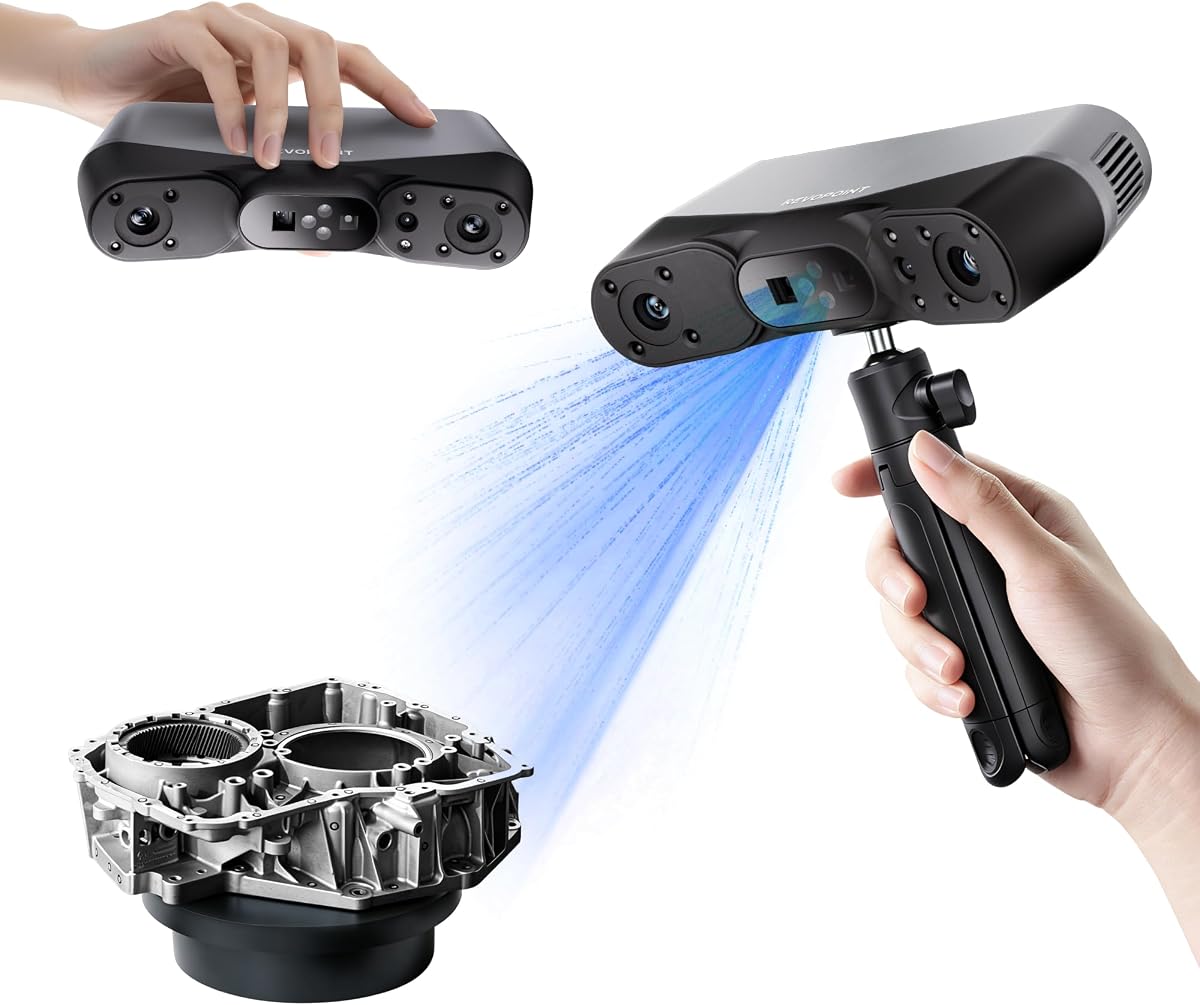
The Revopoint POP 4 delivers industrial-grade accuracy up to 0.03 mm, making it ideal for precision modeling. Its ultra-fast frame rates ensure smooth scanning, perfect for capturing complex scenes and large objects efficiently.
We may earn a commission when you buy through this link, at no additional cost to you.
Multiple scanning modes support diverse needs, from deep holes to reflective surfaces. Outdoor filters allow stable performance in bright sunlight, while AI segmentation simplifies background noise removal for cleaner data output.
Though highly capable, the device is relatively heavy and expensive, which may deter casual users. However, professionals requiring high consistency and detailed geometry will find the investment worthwhile for its performance.
Best suited for reverse engineering and 3D printing applications, the POP 4 combines speed, precision, and robust features. Its comprehensive software suite further enhances post-processing capabilities for expert users.
Achieve single-frame accuracy up to 0.03 mm for faithful reproduction of fine surface details.
Reliable scanning in lighting conditions up to 100,000 lux with outdoor filters for consistent performance.
We may earn a commission when you buy through this link, at no additional cost to you.
The Revopoint INSPIRE 2 is a lightweight yet powerful scanner weighing just 190g. It delivers up to 0.05 mm accuracy and captures true-to-life colors, making it excellent for heritage preservation and product design.
We may earn a commission when you buy through this link, at no additional cost to you.
Dual scanning modules support different materials and environments, while optical zoom helps capture mixed-geometry surfaces. The wireless streaming feature enhances flexibility, allowing real-time preview on mobile devices.
While less accurate than premium industrial models, it offers impressive precision for its size and price. The included accessories ensure you have everything needed to start scanning immediately after purchase.
Ideal for users needing portability without sacrificing too much detail, the INSPIRE 2 balances ease of use and performance. It is well-suited for design professionals and hobbyists working with medium-sized objects.
Built-in WiFi enables real-time PC-to-mobile streaming for seamless remote operations and flexibility.
High-resolution RGB mapping captures vibrant colors and intricate textures automatically synchronized with geometry.
We may earn a commission when you buy through this link, at no additional cost to you.
The Revopoint MetroY Ultra offers industrial-grade precision with single-frame accuracy up to 0.01 mm. This makes it perfect for reverse engineering and tight tolerance measurements in professional environments.
We may earn a commission when you buy through this link, at no additional cost to you.
It supports five versatile scanning modes including full-field structured light and cross-lines for rapid scanning. The ability to scan dark and shiny surfaces without spray saves time and protects delicate parts.
While the cost and setup complexity are high, the quality of data produced justifies the investment. Wi-Fi 6 support and long battery life enhance usability during extended field work sessions.
Best for industrial inspection and precision modeling, the MetroY Ultra delivers reliable, high-quality results. Its feature-rich software ensures seamless workflows from scanning to final design exports.
Flawlessly capture intricate geometric details with up to 0.01 mm single-frame precision.
Directly scan black and metallic components without spray to protect parts and save prep time.
We may earn a commission when you buy through this link, at no additional cost to you.
The Revopoint MetroX Pro combines industrial-grade scanning with intuitive software features. It offers single-frame accuracy up to 0.01 mm and captures up to 7 million points per second for fast, detailed scans.
We may earn a commission when you buy through this link, at no additional cost to you.
Four scanning modes handle different surface types efficiently. The automatic turntable feature simplifies complex object scanning, while cross-line lasers enable direct scanning of reflective or dark surfaces.
Software integration supports reverse engineering and quality inspection workflows. However, advanced features come with paid software options, adding to the overall cost of ownership.
Ideal for precision modeling and manufacturing, the MetroX Pro balances high performance with usability. Its tracking modes and color capture ensure versatile applications across design and engineering.
Automate 3D scanning of complex objects with one-click automatic turntable for efficient workflows.
Effortlessly scan shiny or dark surfaces without spray using cross-line and parallel line modes.
We may earn a commission when you buy through this link, at no additional cost to you.
The 3DMakerpro Fox is an accessible entry-level scanner ideal for beginners and hobbyists. With 0.07mm accuracy, it provides reliable detail for 3D printing and modeling without professional costs.
We may earn a commission when you buy through this link, at no additional cost to you.
Its markerless AI visual tracking relocks onto scanned areas quickly, reducing frustration during manual scanning. The software integrates scanning, editing, and optimizing in a seamless process for ease of use.
While accuracy is slightly lower than premium models, it delivers useful results for most projects. Users benefit from a trusted ecosystem and straightforward tools that make 3D scanning approachable.
Best for those new to scanning or with simpler needs, the Fox offers solid performance and value. It bridges the gap between basic tools and professional systems effectively.
Markerless AI visual tracking quickly relocks on scanned areas to prevent data loss.
Integrated software handles scanning, editing, and optimization in one seamless workflow.
We may earn a commission when you buy through this link, at no additional cost to you.
The Creality Otter Lite features an innovative quad-camera design to capture objects from coins to cars. With 0.05mm accuracy and 30fps speed, it balances detail and efficiency for various applications.
We may earn a commission when you buy through this link, at no additional cost to you.
True-to-life color capture and eye-safe infrared light enhance usability for diverse projects. Its no-spray technology enables direct scanning of dark and metallic surfaces, saving time and resources.
While robust, it requires adequate lighting conditions for best results. The included software supports multiple platforms and AI tools for efficient post-processing and model repair.
Ideal for users needing versatility in scanning size and material, the Otter Lite delivers quality results. It is particularly suited for e-commerce product displays and creative design work.
Four-camera system captures fine details and large coverage for versatile scanning from coins to cars.
Built-in RGB camera with LED lights captures vibrant accurate colors even in dim environments.
We may earn a commission when you buy through this link, at no additional cost to you.
The Creality CR-Scan Ferret SE offers a budget-friendly entry into 3D scanning with anti-shake tracking. It delivers 0.1mm accuracy and 30fps speed, making it accessible for beginners seeking basic functionality.
We may earn a commission when you buy through this link, at no additional cost to you.
Built-in color camera captures vibrant textures, while no-spray capability helps scan dark or metallic objects. The flexible range allows scanning from small parts to larger models efficiently.
Though accuracy is lower than premium models, it suits hobbyist projects well. Software supports basic editing and export, but advanced users may find limitations in complex workflows.
Best for cost-conscious users starting with 3D scanning, the Ferret SE provides essential features at low cost. It is a practical choice for small-scale printing and casual modeling.
Advanced one-shot 3D imaging technology enhances tracking success rate for smooth error-free scans.
Handles objects from 150mm to 2000mm easily for medium to large object scanning.
We may earn a commission when you buy through this link, at no additional cost to you.
The Creality CR-Scan Ferret Pro enhances mobility with WiFi 6 wireless transmission. Offering 0.1mm accuracy and 30fps speed, it delivers fast and reliable performance across various devices.
We may earn a commission when you buy through this link, at no additional cost to you.
Anti-shake tracking improves success rates for smooth scans. The scanner supports iOS and Android devices, making it versatile for fieldwork and remote scanning projects.
While it lacks high-end features, its wireless capability is a strong differentiator. However, highly reflective surfaces require care to avoid scanning issues.
Ideal for users wanting wireless flexibility on a budget, the Ferret Pro suits beginners and casual professionals. Its balance of performance and mobility makes it a smart choice.
Advanced WiFi6 transmission ensures stable efficient data transfer for high-precision scanning.
Improved tracking accuracy ensures smooth error-free scanning even with rapid hand movements.
We may earn a commission when you buy through this link, at no additional cost to you.
The Revopoint MIRACO Plus is an all-in-one 3D scanner with integrated photogrammetric metrology. Featuring 0.04mm accuracy and a powerful quad depth camera, it captures tiny screws to large machinery.
We may earn a commission when you buy through this link, at no additional cost to you.
A 6-inch 2K AMOLED flip screen enables viewing from any angle, while fast charging supports extended sessions. The built-in software allows full workflow management from scanning to editing.
Although it delivers versatile performance, the interface may feel complex. Paid software for CAD conversion adds cost but provides professional-grade capabilities.
Best for comprehensive scanning needs, the MIRACO Plus combines portability with high-end features. It serves professionals and advanced users seeking an all-inclusive 3D scanning solution.
Cost-effective 3D scanner with photogrammetric metrology kit ensures high-resolution capture of small details.
Lightweight 750g design with 2-hour battery supports one-handed use and easy transportation.
We may earn a commission when you buy through this link, at no additional cost to you.
Choosing the right 3D scanner requires understanding key factors affecting performance, cost, and suitability. This guide highlights critical aspects to consider before making a purchase decision.
Accuracy defines how closely the scanned model matches the real object. For precision engineering or reverse engineering, look for scanners with accuracy under 0.05mm. Hobbyists may find 0.1mm sufficient for general purposes.
Higher accuracy generally increases cost but is essential for technical applications. Evaluate your project needs before investing in ultra-precise models.
Scanning speed impacts how quickly you can complete a model. Look for frame rates (FPS) and point acquisition rates to gauge speed. Higher speeds improve productivity for large or complex objects.
While speed is important, it should not compromise accuracy. Balance these factors based on typical use cases.
The range defines the size of objects you can scan. Some scanners handle tiny parts while others accommodate full-body or large industrial components. Check minimum and maximum scan volumes before buying.
Consider the versatility offered by dual modes or zoom options for scanning diverse object sizes.
Most scanners are affected by ambient light. Outdoor or industrial use requires scanners with high lux ratings or laser technologies that resist sunlight. Indoor use typically needs controlled lighting.
Look for models with outdoor filters or laser modes for reliability in varied environments.
Software quality determines ease of post-processing and export. Advanced features like AI segmentation, retopology, and cloud storage enhance workflow. Check compatibility with your operating system.
Paid software may be required for advanced functions. Factor in total software costs when comparing scanners.
Weight and design affect portability. Handheld models under 500g are ideal for on-site work. Battery life and wireless connectivity also support mobility.
Choose lightweight models with long battery life for fieldwork or frequent transport.
RGB cameras enable full-color texture mapping, essential for visual applications. Ensure the scanner supports accurate color reproduction and syncs well with geometry data.
Color accuracy varies across models. Check sample outputs if color fidelity is critical.
Prices range widely from entry-level to industrial. Entry models suit beginners, while professional scanners offer better performance. Consider total cost including accessories and software.
Determine your budget upfront to narrow choices effectively.
Start by calibrating your scanner using the provided board to ensure accuracy. Clean the lenses regularly and store the device in a protective case when not in use to avoid damage.
For best results, scan in good lighting conditions and maintain a steady hand. Use markers if your model recommends them for complex shapes. Follow software guidelines for alignment and alignment.
Export files in appropriate formats like STL or OBJ for 3D printing. Regularly update firmware and software to access new features and performance improvements.
Laser scanners use laser lines to measure distance and work well on shiny surfaces. Structured light projects light patterns for faster scanning and color capture. Both have advantages depending on your object type.
Most scanners struggle with reflective or transparent surfaces. Some models use spray or special modes to improve scanning. Check scanner specifications before attempting challenging materials.
Scan file sizes vary based on resolution and model complexity. High-resolution models can range from tens to hundreds of megabytes. Ensure sufficient storage space on your device or cloud.
Most consumer scanners use eye-safe infrared or visible light. Always follow manufacturer safety guidelines and avoid staring directly into light sources. Class I lasers are typically safe.
Scanners come with dedicated software for processing. Additional tools like mesh repair or CAD converters may be needed. Check compatibility with your OS and workflow requirements before purchase.
Some scanners are designed with outdoor filters and high lux ratings for field use. Others may require shade or controlled lighting. Check specifications to ensure outdoor capability before buying.
We reviewed ten top 3D scanners suitable for different needs and budgets. The Creality Pika stands out for precision and AI features while the Revopoint models lead in industrial applications.
Prioritize accuracy, speed, and software capabilities when choosing your next scanner. Matching the device to your project type ensures satisfaction and efficiency in results.
Remember that pricing and availability can change. Always check current listings to confirm the latest offers before making your final purchasing decision today.