
6-Band Signal Generator 100KHz-150MHz
4.0Editor score
150 MHz frequency range
Low phase noise
Metal housing durable
This guide compares the top Amfm Signal Generator models for precision, range, and modulation support to help engineers choose the right tool for testing.
Selecting the right Amfm Signal Generator is crucial for accurate electronic testing and development. These devices provide stable RF signals essential for calibrating receivers and debugging circuits across various industries.
Our team evaluated ten leading models based on frequency range, modulation capabilities, and user feedback. We compared portability, screen clarity, and signal purity to ensure you find a reliable tool for your specific needs.
Each pick highlights key strengths and limitations to guide your decision. Prices fluctuate frequently, so verify current listings before purchasing. This comprehensive list covers options for hobbyists and professional engineers alike.
4.0Editor score

5.0Editor score

5.0Editor score
We have organized the top ten Amfm Signal Generator options side by side. This comparison table helps you quickly identify differences in frequency output, modulation types, and physical design to find the perfect match for your workflow.




The UNI-T UTG962E stands out as a high-performance handheld solution for RF testing. With a 5.0 rating, it delivers reliable signal generation for electronics enthusiasts and professionals alike.
We may earn a commission when you buy through this link, at no additional cost to you.
Its 60 MHz frequency range and 200 MS/s sample rate provide precise waveform control. The dual channel feature allows simultaneous sine, square, or arbitrary waveforms, ideal for complex circuit debugging.
While limited to 60 MHz compared to higher-end units, its modulation depth and memory storage make it versatile. The lack of a color screen is acceptable given its compact size and price point.
Engineers seeking portability and robust signal quality should consider this model. It balances performance and size effectively for field testing and lab applications.
Two independent outputs let you test differential circuits or compare signal paths without swapping cables.
Support for AM, FM, PM, and FSK ensures you can simulate real-world communication signals accurately.
We may earn a commission when you buy through this link, at no additional cost to you.
The OWON DGE2035 offers a solid alternative for educational labs and research. Its 4.2 rating reflects consistent performance in generating stable arbitrary waveforms.
We may earn a commission when you buy through this link, at no additional cost to you.
With a 3.6 inch TFT LCD, users enjoy clear visual feedback on waveform shapes. The 125MSa/s sampling rate supports precise timing, while PC control enables remote operation during extended tests.
Some users might find 35 MHz limiting for high-frequency RF work. However, its extensive library of 150 built-in arbitrary waveforms simplifies testing common signal patterns.
Ideal for students and educators needing visual aids and remote control, this unit combines usability with technical depth. It is a practical choice for general electronics training.
The color screen helps identify noise or distortion quickly, improving debugging speed in the lab.
Connecting via USB allows software-driven automation for repetitive testing scenarios.
We may earn a commission when you buy through this link, at no additional cost to you.
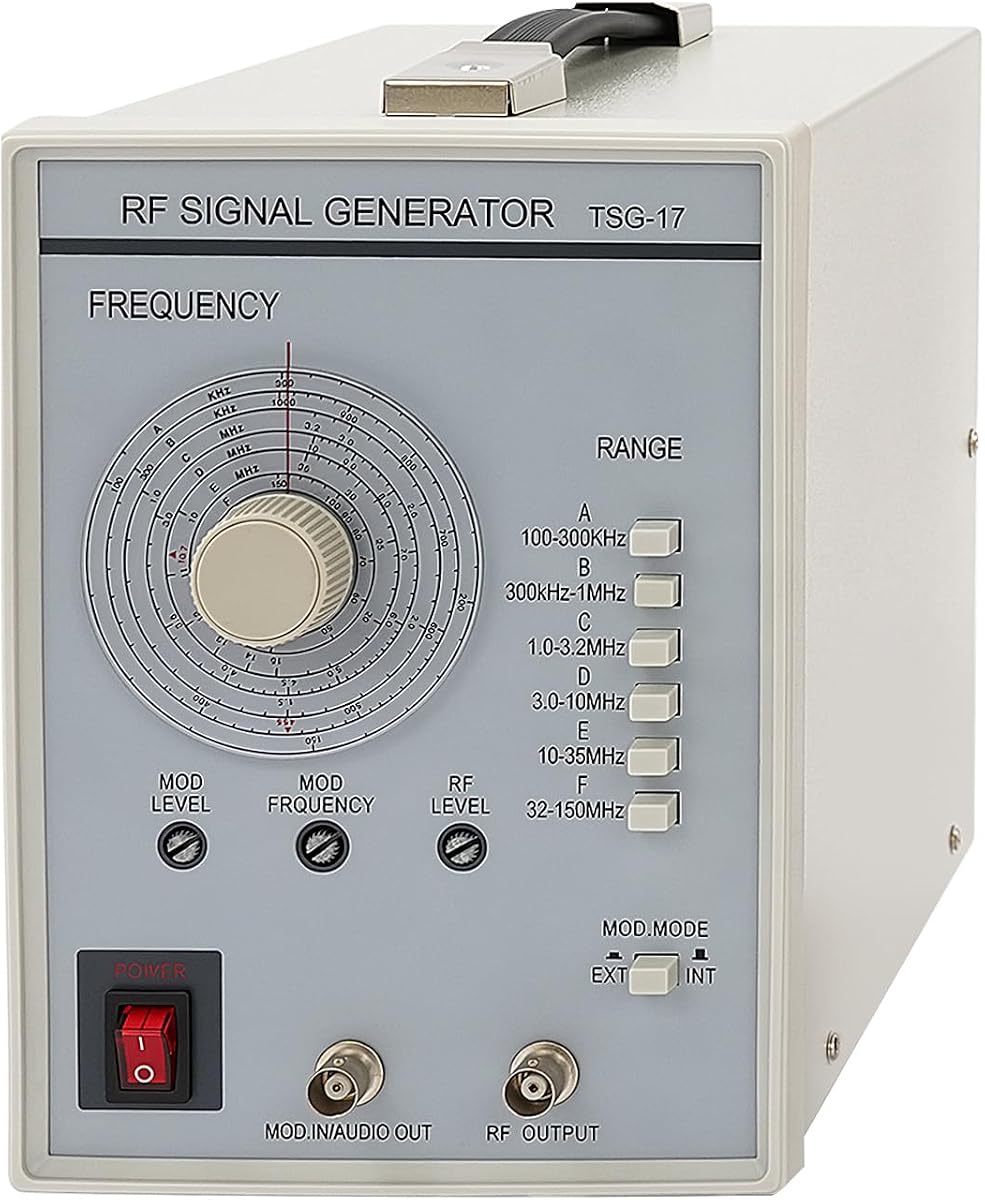
This 6-Band Signal Generator is an economical choice for radio testing and maintenance. With no rating listed but positive user feedback, it focuses on core functionality.
We may earn a commission when you buy through this link, at no additional cost to you.
The 100KHz to 150MHz range covers most AM and FM bands, supported by low phase noise for signal purity. Its metal housing ensures durability in workshop environments.
Trade-offs include a lack of digital screen or advanced arbitrary waveform generation. It uses physical knobs and buttons, which can be slower than menu-driven units but are rugged.
Field technicians requiring a straightforward, portable generator should look here. It provides excellent value for basic modulation tasks without complex features.
The scratch-resistant metal case protects against drops and impacts during transport.
Six distinct ranges allow quick tuning across the spectrum without complex calculations.
We may earn a commission when you buy through this link, at no additional cost to you.
For ultra-high-frequency needs, this unit extends up to 4400MHz. It targets specialized applications where standard generators fall short, though ratings are mixed.
We may earn a commission when you buy through this link, at no additional cost to you.
Its sweep mode and power-off memory allow convenient testing of frequency responses. USB power adds portability, though stability may vary with different sources.
Noise and limited waveform options are notable drawbacks. Users report it works well for simple signal injection but not precision measurement.
Hobbyists needing microwave band signals might find this useful. Ensure your setup can handle potential instability before relying on it for critical work.
Operating up to 4400MHz enables testing of modern wireless protocols beyond standard AM/FM.
Linear sweep mode helps identify resonance points in antenna or filter designs.
We may earn a commission when you buy through this link, at no additional cost to you.
The TSG-17 targets commercial and household use with a focus on AM modulation. However, its 2.5 rating indicates reliability concerns among buyers.
We may earn a commission when you buy through this link, at no additional cost to you.
It covers 100kHz to 150MHz with external modulation capabilities for custom signal shaping. Harmonic outputs allow testing at higher frequencies beyond the base range.
Users mention weight and power requirements as drawbacks. The lack of modern interfaces limits integration with automated systems.
Use it for simple maintenance tasks where basic RF injection is sufficient. Check recent reviews for quality improvements before purchase.
Up to 450MHz via harmonics provides extended reach without extra hardware.
Input external signals between 50Hz and 20KHz to modulate the RF carrier.
We may earn a commission when you buy through this link, at no additional cost to you.
This model specializes in industrial process control signals like 4-20mA rather than RF. It serves well for PLC and valve testing with a 4.1 rating.
We may earn a commission when you buy through this link, at no additional cost to you.
Its 3.7V lithium battery ensures field portability. PWM output allows switching signal generation, useful for testing motor drivers or timers.
It lacks true RF or AM/FM capabilities, making it distinct from traditional signal generators. If you need industrial calibration, it excels; for RF, it is not suitable.
Electronics technicians working with automation systems will find this practical. It simplifies loop testing without external power sources.
With 1500mAh capacity, it lasts several hours during continuous operation in remote areas.
Short circuit and reverse connection protection prevent damage to connected equipment.
We may earn a commission when you buy through this link, at no additional cost to you.
With a 4.6 rating, this Riiai unit provides precise voltage and current outputs for calibration. Its small form factor makes it ideal for handheld diagnostics.
We may earn a commission when you buy through this link, at no additional cost to you.
The 4-digit display ensures accuracy down to 0.01V or 0.01mA. Users can switch between percent and frequency modes for versatile testing scenarios.
It does not offer RF signal generation, focusing solely on analog control. This limits its use to specific automation or sensor calibration tasks.
Maintenance engineers needing quick and accurate current loop checks will appreciate its reliability. It is a specialized tool for precise analog signal needs.
Output accuracy of 0.01V or 0.01mA ensures reliable calibration of sensitive sensors.
Switch between voltage, current, or percent modes easily via the mode button.
We may earn a commission when you buy through this link, at no additional cost to you.
This unit supports multiple signal types including mA, V, and pulse for complex PLC testing. A 4.4 rating confirms its usefulness in industrial settings.
We may earn a commission when you buy through this link, at no additional cost to you.
Real-time curve display and auto ramp functions simplify diagnostic workflows. The 3000mAh battery supports long shifts without charging interruptions.
Like similar units, it lacks RF capabilities. However, its ability to simulate passive and active currents adds significant value for sensor integration.
PLC technicians looking for versatile analog simulation should consider this device. It reduces the need for multiple separate testing tools on the job.
Frequency output from 0 to 9999 Hz helps test digital inputs directly.
Up to 26 hours of operation ensures it lasts through extended field maintenance.
We may earn a commission when you buy through this link, at no additional cost to you.
The DROK unit offers straightforward analog signal generation with a 4.3 rating. It is designed for quick adjustments using a multi-cycle potentiometer.
We may earn a commission when you buy through this link, at no additional cost to you.
Its ability to generate both 0/4-20mA and 0-10V signals from one module saves space. It works well for simple LED or valve testing.
Mechanical knobs lack digital precision compared to encoder-based models. However, for many field applications, this trade-off is acceptable.
Budget-conscious users needing basic current loop signals will find it reliable. It remains a staple for general purpose industrial testing.
One module handles both current and voltage, reducing equipment clutter.
Compact and lightweight design fits easily in a toolbox or pocket.
We may earn a commission when you buy through this link, at no additional cost to you.
The SEESII generator stands out with 5.0 rating and high precision DDS technology. It offers low distortion signals ideal for research and high-end testing.
We may earn a commission when you buy through this link, at no additional cost to you.
Dual independent channels with adjustable phase difference allow advanced circuit analysis. 266MSa/s sampling ensures accurate arbitrary waveforms for custom simulations.
While more expensive and complex than basic units, it provides a full suite of tools. It functions as seven instruments in one, saving space and cost over time.
R&D engineers and serious hobbyists requiring precision will find it superior. It is a premium choice for professional-level electronic development.
Adjustable phase difference from 0 to 359.9 degrees supports differential testing.
266MSa/s sampling enables precise pulse width and timing signal generation.
We may earn a commission when you buy through this link, at no additional cost to you.
Selecting an Amfm Signal Generator requires evaluating several technical factors to match your project needs. This guide highlights key considerations to help you make an informed decision.
Frequency range determines the bandwidth of signals your generator can produce. For standard AM/FM work, 150MHz is often sufficient, but RF design may require higher limits.
Ensure the generator covers the full range of your target application to avoid needing additional equipment.
Modulation support like AM, FM, PM, and FSK affects how well you can simulate real-world signals. Look for models that offer depth control and multiple simultaneous options.
Choose a unit with the necessary modulation depth and types to ensure your tests reflect actual conditions.
Dual channel units allow you to output two signals at once, useful for testing differential pairs or comparing inputs. Single channel generators are simpler and cheaper.
If your work involves phase or amplitude comparisons, invest in a dual channel model.
A clear display helps verify waveform shapes and settings quickly. TFT color screens offer better readability than monochrome or no screens.
Consider models with intuitive menus and shortcut keys to reduce setup time during testing.
Built-in arbitrary waveforms allow custom signal generation beyond standard sine or square waves. More memory depth means longer and more complex patterns can be stored.
Check the number of preset and user-defined waveforms to ensure they meet your specific needs.
Battery power is essential for fieldwork or mobile labs, while AC power suits stationary setups. Look for USB charging or long battery life.
Select a power option that aligns with your working environment to ensure uninterrupted operation.
PC control via USB or other interfaces allows automation and remote testing. This is critical for integration with test suites.
Verify that the generator supports the software or protocol you plan to use for remote control.
Robust casing and high-quality connectors improve longevity in workshop environments. Metal housings offer better protection against impact.
Prioritize durability if you plan to transport the generator frequently between sites.
Start by connecting the generator to a stable power source or ensuring the battery is fully charged. Attach the output cable to your device under test using appropriate connectors.
Set the desired frequency and amplitude using the controls or software interface. Enable AM or FM modulation if needed and adjust depth or frequency parameters accordingly.
After testing, disconnect cables and store the device in a dry place. Regularly clean the display and ports to prevent dust buildup and ensure signal integrity.
AM varies the amplitude of the carrier wave based on the input signal, while FM varies the frequency. AM is simpler but more prone to noise, whereas FM provides better sound quality and signal stability.
Yes, a signal generator with appropriate frequency range and power output can simulate received signals to test antenna performance and SWR. Ensure the output power does not exceed safe limits for the antenna system.
Dual channel generators are necessary if you need to test two signals simultaneously, such as for differential circuits or phase comparison. Single channel models suffice for basic signal injection.
Most modern units include USB or Ethernet ports. Install the required drivers or software to establish communication. Refer to the manual for specific commands and control settings.
Phase noise describes the stability of the signal frequency over time. Low phase noise ensures a cleaner signal, which is critical for high-precision RF testing and communications.
Battery life varies by model, typically ranging from 4 to 20 hours depending on output power. Look for units with larger mAh ratings for extended field work.
Arbitrary waveform output allows custom signal creation, which is vital for testing complex or non-standard protocols. Standard sine and square waves are enough for basic debugging.
Most portable generators output low power for testing purposes only. Do not use them directly to power high power devices; use amplifiers or dedicated power sources.
The UNI-T UTG962E offers the best balance of range and portability for most users. The 6-Band Signal Generator provides an affordable alternative for basic RF tasks.
Prioritize frequency range and modulation types based on your specific testing needs. Dual channels and PC control add flexibility but may increase cost.
Always verify current pricing and availability before purchasing. Models evolve quickly, and checking recent user reviews ensures you select the most reliable unit.