
Arturia KeyLab 88 mk3 88-key Weighted Hammer-action Keyboard Controller – Black
4.3Editor score
Fully weighted hammer-action keys
12 pressure-sensitive performance pads
USB-C power and sheet music stand
This guide compares the top 88 key weighted MIDI controllers for producers and pianists focusing on key action DAW integration and build quality.
Finding the right 88 key weighted MIDI controller is essential for musicians who want a realistic piano feel while producing music on a computer. These devices bridge the gap between traditional acoustic instruments and modern digital audio workstations offering expressive control over virtual instruments and software synthesizers.
We evaluated ten leading models based on their key action quality, feature sets, compatibility with major DAWs, and overall build durability. Our analysis focuses on how well each controller handles dynamic performance while providing the necessary tools for recording mixing and live playback in various studio environments.
Each pick in this list highlights specific strengths such as budget friendliness premium hammer actions or deep software integration. Please note that availability and pricing may vary over time so checking current listings is recommended before making a final purchase decision for your music setup.
4.3Editor score

4.5Editor score

4.6Editor score
The following table provides a side-by-side comparison of the top ten 88 key weighted MIDI controllers available this month highlighting their core specifications and unique selling points.



The M-AUDIO Keystation 88 MK3 stands out as a top choice for producers needing a reliable full-size keyboard without a premium price tag. With a 4.5 star rating from users it delivers consistent performance for controlling virtual instruments within your digital audio workstation.
We may earn a commission when you buy through this link, at no additional cost to you.
Its semi-weighted keys offer a comfortable playing experience that balances speed and control making it ideal for both melodic lines and chord progressions. The USB connectivity ensures you can start creating music immediately without installing drivers or external power supplies.
While it lacks advanced features like aftertouch the controller includes essential transport buttons a volume fader and modulation wheels to shape your sound dynamically. The included software such as Ableton Live Lite adds significant value for beginners setting up their first studio.
This controller is best suited for home studio producers and students who prioritize ease of use and cost effectiveness. If you need a straightforward interface to control your software instruments the Keystation 88 MK3 remains a solid investment for your workflow.
The plug-n-play USB connectivity to Mac or PC means you can start producing music right out of the box without technical hurdles.
Every package includes MPC Beats Ableton Live Lite and additional tools to get you started on professional music production immediately.
We may earn a commission when you buy through this link, at no additional cost to you.
The M-AUDIO Hammer 88 Pro is designed for pianists seeking an authentic acoustic piano feel in their MIDI controller. Featuring graded hammer action keys it replicates the resistance of a real piano offering expressive dynamics that are crucial for classical and jazz performance styles.
We may earn a commission when you buy through this link, at no additional cost to you.
One of its standout features is the Native Kontrol Standard integration which allows seamless control over Native Instruments libraries without complex mapping. The inclusion of 16 RGB backlit pads and multiple faders provides a complete production surface for beat makers and live performers alike.
While it comes with a higher price tag the array of controls and build quality justify the investment for serious professionals. Users note that the keys can produce some mechanical noise during heavy playing which may be audible in quiet studio environments.
This controller is recommended for advanced producers who need deep integration with Native Instruments and a wide range of tactile controls. If you value a traditional piano touch and extensive customization the Hammer 88 Pro delivers a premium experience.
88 velocity-sensitive graded hammer action weighted keys with aftertouch provide a realistic playing experience similar to an acoustic piano.
8 assignable knobs 9 assignable faders and multiple inputs give you complete tactile control over virtual instruments and DAW parameters.
We may earn a commission when you buy through this link, at no additional cost to you.
Arturia's KeyLab 88 mk3 brings a modern aesthetic and robust feature set to the world of full-size MIDI controllers. With fully weighted hammer-action keys it offers a premium playing experience that rivals dedicated digital pianos while maintaining full MIDI control over your studio software.
We may earn a commission when you buy through this link, at no additional cost to you.
The controller includes 12 pressure-sensitive performance pads that respond to dynamics adding an expressive layer to your productions. USB-C power ensures stable connectivity and the inclusion of a sheet music stand shows thoughtful design for players who read notation during sessions.
While it may require more desk space than slimmer alternatives the build quality is exceptional and supports long-term use in professional environments. Some users may find the depth of features initially overwhelming but custom scripts simplify DAW integration significantly.
This model is ideal for composers and producers who need a high-quality piano feel combined with extensive control options. Its balance of classic keyboard mechanics and modern digital features makes it a top contender for serious music production setups.
The 88-key MIDI controller features fully weighted hammer-action keys that provide a realistic and expressive playing experience.
12 pressure-sensitive performance pads allow for dynamic triggering of samples and clips alongside your melodic playing.
We may earn a commission when you buy through this link, at no additional cost to you.
The white variant of the Arturia KeyLab 88 mk3 offers the same premium features as the black model but with a sleek aesthetic that fits modern studio designs. Its fully weighted hammer-action keys ensure that performers experience the same authentic touch and response regardless of color.
We may earn a commission when you buy through this link, at no additional cost to you.
Key features include 12 pressure-sensitive performance pads for beat production and a robust control section that integrates deeply with major DAWs. The USB-C power connection provides reliability and the included sheet music stand aids musicians who rely on written scores during composition.
While it sits at a premium price point the build quality and feature set justify the cost for professional users. Some buyers note that the white finish may show fingerprints more easily than darker finishes requiring occasional cleaning to maintain its pristine look.
This controller is best suited for producers who value both performance and aesthetics in their studio setup. If you seek a full-size keyboard that combines a realistic piano feel with modern connectivity options this white edition is an excellent choice.
88-key MIDI controller with fully weighted hammer-action keys provides a realistic and expressive playing experience for professionals.
12 pressure-sensitive performance pads enable dynamic control for triggering samples and clips seamlessly alongside key playing.
We may earn a commission when you buy through this link, at no additional cost to you.
The Novation Launchkey 88 [MK3] is widely praised for its deep integration with digital audio workstations making it a favorite for electronic music producers. Its premium semi-weighted keybed offers a responsive feel that supports fast playing styles while remaining light enough for extended use.
We may earn a commission when you buy through this link, at no additional cost to you.
Key features include a powerful arpeggiator with Strum Mode that unlocks new melodic ideas instantly. The inclusion of Creative Scale and Chord Modes helps musicians compose complex harmonies without advanced theory knowledge speeding up the songwriting process.
While the keys are semi-weighted rather than fully hammer weighted they still provide enough resistance for expressive performance. Users appreciate the 16 velocity-sensitive pads and the flexibility of Custom Modes which allow tailored control over external hardware and software.
This controller is recommended for producers who prioritize workflow efficiency and DAW connectivity over a heavy hammer action. If you work primarily within a digital environment and need a versatile interface the Launchkey 88 delivers exceptional value.
Deep integration across all leading DAWs provides immediate access to all the controls you need without complex setup.
Creative Scale and Chord Modes let you trigger chords with one finger making composition more intuitive and accessible.
We may earn a commission when you buy through this link, at no additional cost to you.
The Studiologic SL88 MK2 is designed for performers who need a portable yet fully weighted MIDI controller for stage use. Its 88-key keyboard features weighted keys that replicate a natural piano feel while maintaining a slim profile that fits easily into gig bags.
We may earn a commission when you buy through this link, at no additional cost to you.
An onboard display simplifies the adjustment of settings allowing you to change zones and mappings quickly during a performance. The 7 encoders provide ample control for adjusting parameters on synthesizers or effects units without needing to navigate menus on your computer.
While it is priced higher than entry-level options the build quality and portability make it a worthy investment for touring musicians. Some users might prefer more encoders but the current layout is well balanced for most live performance scenarios.
This controller is best for live performers who need a reliable and portable full-size keyboard. Its balance of weight and control options makes it a standout choice for those who move frequently between venues and home studios.
Numa Player compatibility ensures seamless integration with virtual instruments for a wide range of sound libraries.
An onboard display allows for quick adjustment of settings and zones without needing to look at a computer screen.
We may earn a commission when you buy through this link, at no additional cost to you.
The YAMAHA P71 is primarily known as a digital piano but its weighted action makes it a viable option for MIDI control when paired with a host computer. It offers an acoustic piano feel with touch-sensitive keys that allow for true expression and dynamic performance.
We may earn a commission when you buy through this link, at no additional cost to you.
Users can choose from 10 unique Voices including the richness of a Yamaha grand piano with full dynamic sound and deep bass. The layered sound mode lets you blend two Voices such as piano and strings to create a rich inspiring playing experience.
While it lacks the extensive MIDI mapping features of dedicated controllers its simplicity is a strength for those focused on playability. The included sustain pedal allows for subtle variations and greater expression enhancing the overall performance experience significantly.
This instrument is ideal for pianists who prioritize key action over complex MIDI controls. If you want a keyboard that feels like a real piano while offering MIDI connectivity the P71 is a solid choice for practice and composition.
Touch-sensitive keys allow for true expression and dynamic performance replicating the acoustic piano experience accurately.
Dual Mode lets you blend two Voices creating a rich layered sound for an inspiring new playing experience.
We may earn a commission when you buy through this link, at no additional cost to you.
The Arturia KeyLab Essential mk3 offers a unique hybrid synth-piano feel that bridges the gap between traditional pianos and modern synthesizers. Its waterfall keybed expanded to a full 88-key range provides a comfortable surface for players who transition between different styles.
We may earn a commission when you buy through this link, at no additional cost to you.
New creative features like Scale Mode Chord Mode and Arpeggiator make composition more intuitive than ever. The inclusion of Analog Lab Pro with over 2000 presets ensures you have a vast library of sounds ready to use right out of the box.
While the keybed may feel different from a standard weighted hammer action it offers a modern touch that suits electronic music production well. The bright LCD screen and RGB-backlit pads provide clear visual feedback enhancing your workflow during complex sessions.
This controller is best for electronic producers and songwriters who need a versatile and modern interface. If you value creative tools and sound variety over a traditional hammer action the KeyLab Essential mk3 is an excellent addition to your studio.
The same comfortable waterfall keybed expanded to full piano range for musical expression normally reserved for premium stage keyboards.
Scale Mode Chord Mode and Arpeggiator make composition songwriting and beat-making more intuitive than ever.
We may earn a commission when you buy through this link, at no additional cost to you.
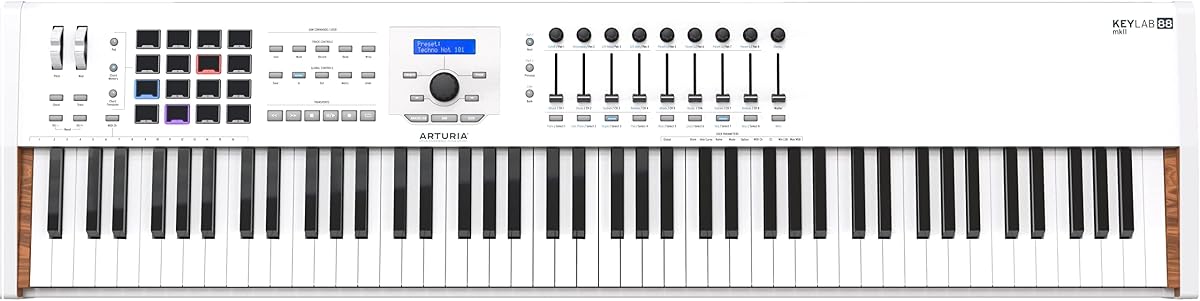
The Arturia KeyLab 88 MkII is a powerhouse for producers who need extensive hands-on control over their virtual instruments. Its Fatar TP/100LR keybed ensures a premium feel with full aftertouch and velocity sensitivity for nuanced expression.
We may earn a commission when you buy through this link, at no additional cost to you.
The control bank includes 9 faders and 9 rotary knobs allowing for deep modulation of parameters during recording and mixing. 16 RGB-backlit performance pads offer versatility for drum programming and clip triggering while enhancing the visual aspect of your setup.
While it does not include a stand and occupies significant desk space the functionality it provides is unmatched in this category. Users consistently praise its reliability and the quality of the included Analog Lab V software which adds immense value to the purchase.
This model is recommended for professional producers who require maximum control and a high-quality keybed. If you need a comprehensive studio instrument that handles everything from melody to arrangement the MkII delivers exceptional performance.
88 note Fatar TP/100LR keybed ensures high quality aftertouch velocity sensitive hammer-action and piano feel for performance.
Control bank with 9 faders and 9 rotary knobs provides extensive control options for DAWs and virtual instruments.
We may earn a commission when you buy through this link, at no additional cost to you.
The Roland A-88MKII is built for durability and performance utilizing premium materials like wood to ensure it lasts for years. Its PHA-4 keyboard offers unmatched playability delivering a responsive feel that professional pianists trust for serious work.
We may earn a commission when you buy through this link, at no additional cost to you.
Three customizable zones allow you to split and layer sounds effectively for live performance scenarios. The thin design with shallow depth fits well into modern studio environments where space is at a premium while still providing all necessary connectivity.
While it comes with the highest price tag in this list the build quality and unique features justify the investment for those who value longevity. MIDI 2.0 readiness ensures it will remain compatible with future advancements in audio technology.
This controller is best for touring musicians and professionals who need a reliable and robust instrument. If you are looking for a controller that combines premium materials with advanced playability the A-88MKII is a top-tier choice.
Unmatched playability with Roland's own PHA-4 keyboard ensures responsive feel and precision for professional performance.
Built-to-last with wood and premium materials ensures years of dependable performance in various touring and studio conditions.
We may earn a commission when you buy through this link, at no additional cost to you.
Selecting the right controller requires understanding your specific needs regarding key feel control surface features and budget constraints.
The most critical factor in a weighted MIDI controller is the key action which determines how the keys feel under your fingers. Options range from semi-weighted keys that offer a lighter and faster response to fully weighted hammer-action keys that simulate the resistance of an acoustic piano. If you play classical or jazz piano extensively a hammer-action keybed will provide the necessary dynamic range and realism for your performances.
For electronic music producers who prioritize speed and synthesis play semi-weighted keys might be more comfortable. It is essential to test the keys personally or read user reviews to ensure the action matches your playing style.
Aftertouch allows you to modulate sound after pressing a key down adding expressive elements like vibrato or filter sweeps to your performance. Many high-end controllers include this feature but it is often absent in more budget-friendly models. If you plan on using synthesizers that respond to aftertouch ensuring your controller supports this will unlock deeper creative possibilities.
Without aftertouch you may have to automate effects manually using a mouse which can be less intuitive during live recording. Consider whether your workflow benefits from this real-time modulation before dismissing models that lack it.
Seamless integration with your Digital Audio Workstation is a major productivity booster when using a MIDI controller. Manufacturers often provide custom scripts or pre-mapped controls for software like Ableton Live Logic Pro or FL Studio allowing you to adjust track volumes or trigger clips with a touch. Deep integration can significantly reduce the need to look at your screen during creative sessions.
Before purchasing check if the controller supports your specific DAW out of the box. Some models require manual mapping which can be time-consuming for beginners. A controller with native support simplifies your workflow and lets you focus on making music rather than configuring hardware.
Beyond the keys a modern MIDI controller often includes additional controls like faders knobs and drum pads. These features allow you to manage multiple aspects of your project without reaching for the mouse. 16 velocity-sensitive pads are standard for beat makers while 8 or more faders are useful for managing track levels and mixes simultaneously.
If your workflow relies heavily on live performance or detailed mixing these extra controls are invaluable. Conversely if you mainly use the keyboard for melodic input a simpler layout might save space and money. Assess your typical session activities to decide which features are necessary for your specific needs.
Construction quality determines how well the controller will withstand regular use and potential travel. Models with wood reinforcements and metal chassis are more durable but often heavier than those made from plastic. If you plan to transport your equipment to gigs or different studios a lighter unit with a slim profile is advantageous.
However if the controller will stay stationary on a desk build quality focuses on stability and resistance to wear. Consider where you will place the unit and how often you move it before finalizing your choice to ensure it meets your physical requirements.
Many MIDI controllers come bundled with software instruments and effects that can jumpstart your production journey. These packages often include synthesizers samplers and DAW versions that save you money on initial setup. While these tools are useful check if they meet your quality standards and if they are fully functional or trial versions.
A controller with a strong software ecosystem can enhance its value significantly. However avoid making a purchase solely based on software if the hardware itself does not meet your needs. The hardware should remain the priority with software treated as a valuable bonus.
Modern controllers typically connect via USB but some still offer traditional 5-pin MIDI outputs for connecting to external gear. USB-C is becoming the standard for power and data transfer offering faster speeds and more reliable connections. Ensure the controller supports your computer's port types to avoid buying extra adapters.
Additional inputs for sustain pedals and expression controllers expand your performance capabilities significantly. Check how many inputs are available to ensure you can connect all the accessories you plan to use. A versatile connectivity layout future-proofs your purchase against hardware upgrades.
Prices for 88 key controllers vary widely ranging from affordable entry-level units to high-end professional models. It is important to determine a budget that reflects your current needs without overspending on features you will not use. Often the mid-range models offer the best balance of quality and functionality for most producers.
Consider the total cost of ownership including any required accessories like stands or cables. A slightly more expensive unit that includes essential accessories might offer better overall value than a cheaper one that requires separate purchases. Always compare what is included in the box to get an accurate picture of value.
To begin using your new controller connect it to your computer via the provided USB cable and launch your digital audio workstation. Most modern controllers are plug-and-play requiring no drivers so you should see your device listed in the MIDI preferences immediately after connection.
Take time to map the knobs and pads to your software functions manually if they are not automatically recognized. This customization allows you to tailor the control surface to your specific workflow ensuring that essential parameters are always at your fingertips.
Regular maintenance involves gently cleaning the keys with a dry soft cloth to remove dust and oils from playing. Avoid using liquid cleaners directly on the surface and store the controller in a cool dry place when not in use to protect the internal electronics.
Yes many 88 key MIDI controllers are designed with portability and durability in mind for live use. They often include features like weighted keys for realism and multiple outputs for connecting to mixers. Just ensure the weight fits your transport needs for gigs.
Most modern 88 key MIDI controllers are plug-and-play and do not require specific drivers to function. They are recognized automatically by Mac and Windows systems. However some advanced mapping features might require manufacturer software for full customization.
Semi-weighted keys offer a lighter spring-loaded action that allows for faster playing speed and ease of movement. Hammer-action keys simulate the weight and mechanical feel of an acoustic piano with graded resistance across the range. Choose based on whether you prioritize speed or realism.
Many controllers support iOS and Android devices via adapters or USB-C connections. You will likely need an external power source as mobile devices may not supply enough power for the controller. Check compatibility specifications for your specific mobile setup.
Most 88 key MIDI controllers do not include built-in sounds as they are designed to control external software or hardware synthesizers. Some bundles include software instruments but the hardware itself typically acts as a controller. You will need a host computer to generate the audio.
Aftertouch allows you to manipulate sound parameters after a key has been pressed adding depth and expression to your performance. It can control effects like vibrato or filter cutoffs in real-time without lifting your fingers. It is essential for expressive synth and piano sounds.
We have reviewed ten top-rated models ranging from affordable entry points to premium professional tools. The M-AUDIO Keystation 88 MK3 offers excellent value for beginners while the Arturia KeyLab 88 mk3 provides advanced features for serious producers.
When making your decision prioritize the key action that best suits your playing style and the integration features that fit your workflow. Whether you need a light semi-weighted surface or a heavy hammer action the right controller will significantly enhance your creative output.
Remember that prices and availability can change so check current listings before finalizing your purchase. Investing in a quality instrument ensures years of reliable performance for your music production needs.