
Donner Amp Attenuator Pedal
4.3Editor score
Mute footswitch included
FX loop integration
Compact pedalboard design
Discover the top attenuator for tube amp options compared for tone retention and volume control across budget and premium models for guitarists in 2026.
Tube amplifiers deliver rich tones but often demand high volume. An attenuator for tube amp solves this by reducing output while preserving dynamics and saturation for home or studio use.
We evaluated ten top models based on power handling, impedance matching, tonal coloration, and build quality. Our selection covers passive and active designs suited for various amplifier wattages and budgets.
Each pick highlights core strengths and ideal use cases. Prices and availability change frequently, so verify current details before purchasing. Use this guide to find the right balance between power and control.
4.3Editor score

4.5Editor score

4.3Editor score
The following table compares key specifications and features across all ten selected attenuators to help you identify the model that best matches your amplifier and recording needs.




The Two Notes Torpedo Captor stands out as a top attenuator for tube amp, offering a reactive load that protects your amplifier while reducing volume. It earns strong marks for maintaining tonal integrity without adding coloration.
We may earn a commission when you buy through this link, at no additional cost to you.
Its passive design ensures reliability with no power needed. The direct box output simplifies connection to recording interfaces or mixers, making it ideal for silent recording sessions.
Trade-offs include a single impedance option and no built-in speaker simulation, which may require an external cab sim pedal for some users. However, these are minor compared to its core performance.
This unit is perfect for players seeking a straightforward attenuator with professional output options. It balances price and performance better than many competitors.
Use the DI output to connect directly to your interface and record without a microphone.
Reactive load design mimics a real speaker to keep your amp feeling natural at low volumes.
We may earn a commission when you buy through this link, at no additional cost to you.
The Donner Amp Attenuator Pedal offers an accessible entry point into tube attenuation. It fits easily on pedalboards and delivers a clean signal path with minimal tone loss.
We may earn a commission when you buy through this link, at no additional cost to you.
Its mute footswitch provides instant silent control, useful during transitions between songs or setups. The output level knob allows precise volume adjustment without affecting tone quality.
It lacks a dedicated line output and is best suited for lower wattage amps. Still, for budget-conscious players, it delivers reliable performance with solid build quality.
Choose this if you need a simple attenuator that integrates seamlessly into your existing pedalchain without adding complexity or cost.
Its small footprint and true bypass design make it easy to place anywhere in your chain.
Tap the mute footswitch to silence output instantly during breaks or setup changes.
We may earn a commission when you buy through this link, at no additional cost to you.
The Boss WAZA Tube Amp Expander represents the pinnacle of tube attenuation technology. Its adaptive impedance tuning ensures your amp responds naturally regardless of volume level.
We may earn a commission when you buy through this link, at no additional cost to you.
With MIDI control and recallable presets, it suits performers who need consistent tone across venues. The built-in power amp also allows you to drive external cabinets without an additional unit.
While costly and feature-rich, it may overwhelm casual users. The learning curve is real, but the result is unmatched flexibility and tone accuracy.
This is the ideal choice for touring professionals and studio engineers who demand total control and reliability from their signal chain.
Adjust the load to match your amp perfectly for optimal dynamics and response.
Use footswitches or external controllers to recall settings and adjust attenuation live.
We may earn a commission when you buy through this link, at no additional cost to you.
The Universal Audio Ox Amp Top Box transforms how you record guitar at low volumes. It combines attenuation with virtual mic placement to deliver studio-quality tones without a real cab.
We may earn a commission when you buy through this link, at no additional cost to you.
Its reactive load ensures your amp behaves naturally while you control attenuation directly from the front panel. The dynamic speaker modeling captures cone cry and breakup details accurately.
Cost and reliance on UA software may limit some users. However, for those seeking a complete solution for silent recording, it excels in tonal realism.
Select this if you want a standalone solution that replaces both an attenuator and a cabinet simulator with precision and reliability.
Get professional cabinet tones directly without setting up mics in a live room.
Feel the natural breakup and drive of your speaker simulated through analog and digital processing.
We may earn a commission when you buy through this link, at no additional cost to you.
Tone King's Ironman II 100W provides robust attenuation for high wattage tube amplifiers. Its reactive load maintains the natural interaction between tubes and speakers even at reduced volumes.
We may earn a commission when you buy through this link, at no additional cost to you.
The presence switch lets you adjust high frequency content, which can soften the tone during attenuation. A DI output adds convenience for direct recording without extra gear.
Its size and weight may be impractical for gigging players. Still, the tonal performance and power capacity justify its place for dedicated studio or home use.
Choose this if you own a high wattage head and need reliable attenuation that keeps your amp feeling responsive and authentic.
Designed to handle amps up to 100 watts, making it ideal for powerful tube heads.
Use the presence switch to compensate for high end loss when attenuation reduces volume.
We may earn a commission when you buy through this link, at no additional cost to you.
The Ironman II Mini delivers the same reactive load quality as its larger sibling in a smaller package. It is perfect for 15 to 30 watt tube amps commonly used in home studios.
We may earn a commission when you buy through this link, at no additional cost to you.
A footswitchable boost adds versatility for lead tones while maintaining consistent attenuation. The compact size saves space on boards or racks without sacrificing performance.
It cannot handle higher wattage amps and is restricted to 8 ohm operation. But within its range, it offers excellent tone preservation and simplicity.
Select this if you run a lower wattage setup and want a compact, reliable attenuator that keeps your tone intact at any volume.
Its compact form factor fits easily on pedalboards or small racks.
Use the boost footswitch to add gain for solos without changing your overall volume.
We may earn a commission when you buy through this link, at no additional cost to you.
Bugera's POWER SOAK PS1 supports multiple impedance settings, making it compatible with a wide range of amps. This flexibility is rare at its price point and adds significant value.
We may earn a commission when you buy through this link, at no additional cost to you.
It includes both line and emulated mic outputs, giving you options for connecting to interfaces or PA systems. The passive design keeps it simple and reliable for daily use.
Lack of tone shaping features and a simple interface may limit advanced users. However, its core attenuation performance remains consistent and transparent.
Choose this if you need an affordable attenuator that matches various impedances and offers direct outputs for recording or live mixing.
Inputs for 4, 8, and 16 ohms let you connect to almost any speaker cabinet.
Use the emulated mic output for direct recording without needing an external mic.
We may earn a commission when you buy through this link, at no additional cost to you.
The JHS Little Black Amp Box is a straightforward solution for reducing amp volume without changing tone. It runs through the effects loop and controls signal going to the power section.
We may earn a commission when you buy through this link, at no additional cost to you.
Its passive design needs no power and uses high grade components to ensure a clear signal path. The compact size and rugged build make it ideal for live or home use.
It lacks output controls and extra features, focusing purely on attenuation. This simplicity is its strength but may not suit those needing more versatility.
Select this if you value simplicity and tone purity, and need a dependable attenuator that does one job very well.
High grade components ensure that your tone stays clear and free from coloration.
Being fully passive means you never need to worry about power supplies or batteries.
We may earn a commission when you buy through this link, at no additional cost to you.
Warm Audio's Reamper Routing Hub doubles as an attenuator with variable impedance control. It suits studio environments where flexible routing and silent load options are essential.
We may earn a commission when you buy through this link, at no additional cost to you.
Independent preamp reamp paths give you total control over signal flow. The 50W silent soak ensures no sound escapes during sensitive recording takes.
It is designed for racks rather than pedalboards, limiting its mobility. However, in a studio setting, its versatility and silence are unmatched.
Choose this if you need a routing hub that integrates attenuation for studio flexibility and precise control over your amplifier signal.
Separate paths for preamp and reamp signals give you total flexibility.
The 50W soak provides a silent load for recording without disturbing others.
We may earn a commission when you buy through this link, at no additional cost to you.
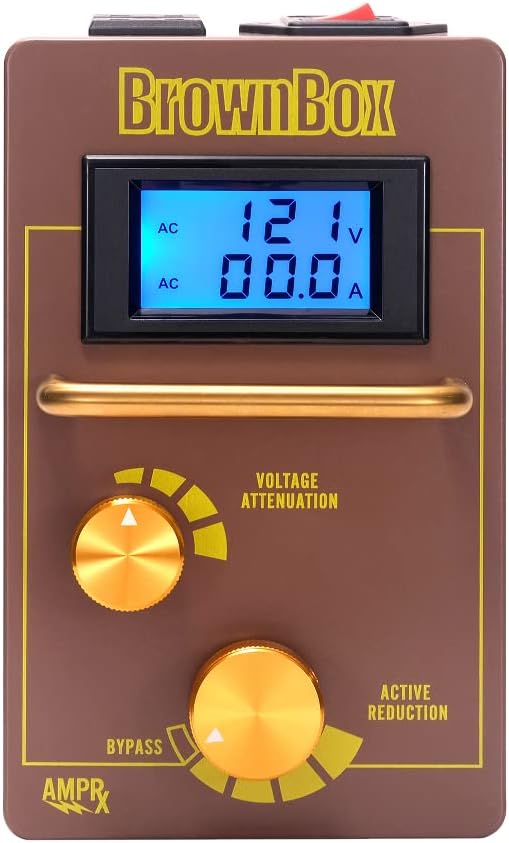
The BrownBox Tube Amplifier Input Voltage Attenuator is unique as it stabilizes AC voltage for tube amps instead of signal. This protects your gear from power fluctuations that can harm components.
We may earn a commission when you buy through this link, at no additional cost to you.
Its LCD volt meter displays real time voltage for precise monitoring. You can select input and output voltages to match your amp's requirements across regions.
It does not attenuate audio signal like other units on this list. Still, for voltage stability and protection, it performs flawlessly and is highly rated by users.
Select this if you want to protect your tube amplifier from unstable power sources and ensure consistent voltage delivery.
Stabilize incoming power to prevent damage from voltage spikes or drops.
Use the built in LCD to monitor exact voltage levels at all times.
We may earn a commission when you buy through this link, at no additional cost to you.
Choosing the right attenuator involves matching power handling, impedance, and features to your specific amplifier and usage environment. These factors ensure reliability and tonal accuracy.
Ensure the attenuator supports your amplifier wattage to prevent overheating or damage. A 100 watt attenuator suits most common tube heads comfortably.
Match wattage ratings to your amp for safe and reliable operation.
Check that the attenuator's impedance options match your speaker cabinet. Mismatched impedance can cause tone loss or damage the amp.
Select an attenuator that supports 4, 8, or 16 ohm as needed.
Reactive models mimic speaker behavior for better tone retention at low volume. Resistive types are simpler but may alter dynamics and feel.
Prefer reactive designs for natural feel and minimal coloration.
Line or DI outputs make it easier to connect to recording interfaces or mixers. Consider whether you need direct routing options.
Choose units with outputs that match your recording or live setup.
Some attenuators include presence or boost controls to compensate for tone changes during attenuation. These features add versatility but cost more.
Decide if you need tone compensation tools for your specific needs.
For touring or gigging, prioritize compact and durable models with pedal-friendly formats. Home users may favor rack or larger units.
Select a build that suits your mobility and storage requirements.
In areas with unstable power, consider voltage regulators for tube amp safety. These protect electronics but do not attenuate audio.
Add a voltage attenuator if your region has unreliable mains supply.
Prices range significantly from basic passive units to feature rich premium models. Set a budget that balances performance and required features.
Invest in quality where it matters most for your use case.
Connect the attenuator between your amplifier's speaker output and your speaker cabinet or load box. Ensure all connections match impedance ratings to prevent damage.
Start with the attenuator set to bypass or minimum attenuation to dial in tone before adjusting levels. Once satisfied, reduce volume gradually while monitoring tone integrity.
Store the unit in a dry, ventilated area and inspect cables regularly for wear. Clean connectors periodically to ensure optimal signal transfer and reliability.
An attenuator reduces the volume output from a tube amplifier while allowing the power tubes to operate at saturation. This lets you get full tone at lower volumes without changing the amp settings.
Most attenuators can slightly change tone at low volumes. Reactive models reduce this impact by mimicking speaker impedance. High quality units are designed to preserve your amp's natural dynamics.
You can use an attenuator with any tube amp if it supports the correct wattage and impedance. Always check compatibility before connecting to avoid damage to the amplifier or speaker.
Some attenuators require a speaker load while others act as loadboxes. If your unit includes a load function you may not need a speaker. Check your specific model requirements.
It is not mandatory but highly helpful for silent recording. Attenuators allow you to run the amp at full power without loud noise. This is ideal for home studios or late night sessions.
Yes passive models need no power while active ones do. Passive attenuators are simpler and reliable. Active models often include extra features like built-in DI or tone shaping.
Impedance matching is critical for safety and tone. Mismatched impedance can cause power issues or poor sound. Always match the attenuator to your speaker or amp output impedance.
A quality attenuator can last many years with proper care. Heat is the main stress factor so ensure ventilation. Avoid overloading it with higher wattage than rated.
We highlighted ten attenuators that deliver reliable performance across budgets. Top picks include the Two Notes Torpedo Captor for versatility and Donner for pedalboard integration.
Prioritize power handling and impedance matching first. If you need tone shaping or recording outputs choose a feature rich model. Simpler passive units work well for basic volume reduction.
Verify current availability and pricing before purchasing as these can change. The right attenuator will help you enjoy tube amp tone anytime and anywhere.